Fantasy Flight Games [News] - Tricks and Taunts in The Dead Marshes:
'via Blog this'
 “His Eye is now straining towards us, blind almost to all else that is moving. So we must keep it. Therein lies all our hope. This, then, is my counsel. We have not the Ring. In wisdom or great folly it has been sent away to be destroyed, lest it destroy us. Without it we cannot by force defeat his force. But we must at all costs keep his Eye from his true peril. We cannot achieve victory by arms, but by arms we can give the Ring-bearer his only chance, frail though it be.”
–Gandalf, Return of the King
There aren’t many instances in J.R.R. Tolkien’s The Lord of the Rings of heroes taunting their foes to distract them or draw their assaults away from weaker allies. More often, the heroes are hard pressed to survive by any means, finding themselves in situations too dark and grim to make jibes. Still, as The Dead Marshes introduces the Song of Mocking(The Dead Marshes, 99) to The Lord of the Rings: The Card Game we find precedent for larger ruses in Tolkien’s works. Most notably, based on Gandalf’s counsel in Minas Tirith, the Lords of Gondor and Rohan led an army of seven thousand to the Black Gates of Mordor, where they were prepared to be defeated by Sauron’s forces, merely to distract his attention long enough to let the Ring slip beneath his gaze on its route to Mount Doom.
Lured into danger
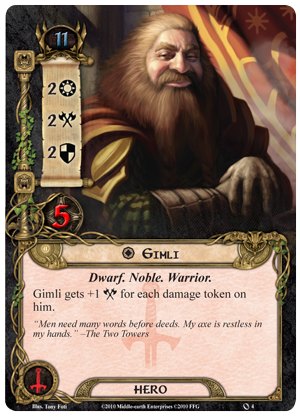
Song of Mocking doesn’t make so historic an impact in the world of Middle-earth, but it can be put to good use in the right deck. Because the flavor quotes The Hobbit and cites Bilbo, players may be led to consider playing it on Bilbo Baggins(The Hunt for Gollum, 1), but Bilbo’s low hit points make him a poor candidate for the attachment. Instead, the attachment’s sphere of influence provides the first suggestion for one of its better targets. You need Tactics resources to play Song of Mocking, and even though heroes can now gain the Tactics icon via Song of Battle (The Dead Marshes, 104) the easiest way to gain Tactics resources is still playing a Tactics hero… such as Gimli (Core Set, 4), who benefits from each point of damage redirected to him.
Players have often tempted fate by choosing to have Gimli defend massive attacks, hoping that he’d survive the enemy’s strike, only to become stronger for his eventual counterattack. Accordingly, Gimli has often fallen in games when the Shadow cards turned against him. Song of Mocking offers an alternate strategy to launch an angry Gimli into battle. Players can defend with Bilbo Baggins or Denethor (Core Set, 10), heroes with reasonably high Defense strength, but low hit points. Instead of placing the wounds on them, they can redirect those wounds to Gimli who, because he didn’t need to defend to survive the attack, can counterattack immediately afterward.
To ensure the damage doesn’t spill over Gimli’s available hit points, players can take advantage of the Lore icon both Bilbo Baggins and Denethor share to play A Burning Brand (Conflict at the Carrock, 33), rendering Shadow effects against them harmless, and guaranteeing that your combat goes according to plan.
Profit from mockery
While the ability to use Song of Mocking to more effectively combine Denethor’s defense and Gimli’s attack may increase the number of Lore / Tactics decks, Song of Mocking can also power the engine formed by Glóin (Core Set, 3) andSelf Preservation (Core Set, 72). Players have long harnessed the synergy between these cards, defending enemies with Glóin to gain resources for each wound he takes, then healing wounds with Self Preservation to repeat the actions again in subsequent turns.
The problem, as it is, with this strategy is that Glóin isn’t particularly suited to defense, with only one Defense strength and four hit points. His two Willpower makes him better for questing, but when he performs a Song of Mocking, Glóin can both quest and profit by drawing damage away from another hero.
While the Tactics sphere isn’t immediately as powerful as the other spheres in truly well-rounded decks, it features some of the most powerful tricks in the game. Along with Feint (Core Set, 34) and Quick Strike (Core Set, 35), Song of Mocking allows Tactics players to further stamp their mastery of combat upon the game.
Look for Song of Mocking, Song of Battle, and a new one-cost Eagle ally to greatly increase deckbuilding options for Tactics players with the upcoming release ofThe Dead Marshes.
'via Blog this'
–Gandalf, Return of the King
There aren’t many instances in J.R.R. Tolkien’s The Lord of the Rings of heroes taunting their foes to distract them or draw their assaults away from weaker allies. More often, the heroes are hard pressed to survive by any means, finding themselves in situations too dark and grim to make jibes. Still, as The Dead Marshes introduces the Song of Mocking(The Dead Marshes, 99) to The Lord of the Rings: The Card Game we find precedent for larger ruses in Tolkien’s works. Most notably, based on Gandalf’s counsel in Minas Tirith, the Lords of Gondor and Rohan led an army of seven thousand to the Black Gates of Mordor, where they were prepared to be defeated by Sauron’s forces, merely to distract his attention long enough to let the Ring slip beneath his gaze on its route to Mount Doom.
Lured into danger
Song of Mocking doesn’t make so historic an impact in the world of Middle-earth, but it can be put to good use in the right deck. Because the flavor quotes The Hobbit and cites Bilbo, players may be led to consider playing it on Bilbo Baggins(The Hunt for Gollum, 1), but Bilbo’s low hit points make him a poor candidate for the attachment. Instead, the attachment’s sphere of influence provides the first suggestion for one of its better targets. You need Tactics resources to play Song of Mocking, and even though heroes can now gain the Tactics icon via Song of Battle (The Dead Marshes, 104) the easiest way to gain Tactics resources is still playing a Tactics hero… such as Gimli (Core Set, 4), who benefits from each point of damage redirected to him.
Players have often tempted fate by choosing to have Gimli defend massive attacks, hoping that he’d survive the enemy’s strike, only to become stronger for his eventual counterattack. Accordingly, Gimli has often fallen in games when the Shadow cards turned against him. Song of Mocking offers an alternate strategy to launch an angry Gimli into battle. Players can defend with Bilbo Baggins or Denethor (Core Set, 10), heroes with reasonably high Defense strength, but low hit points.
Instead of placing the wounds on them, they can redirect those wounds to Gimli who, because he didn’t need to defend to survive the attack, can counterattack immediately afterward.To ensure the damage doesn’t spill over Gimli’s available hit points, players can take advantage of the Lore icon both Bilbo Baggins and Denethor share to play A Burning Brand (Conflict at the Carrock, 33), rendering Shadow effects against them harmless, and guaranteeing that your combat goes according to plan.
Profit from mockery
While the ability to use Song of Mocking to more effectively combine Denethor’s defense and Gimli’s attack may increase the number of Lore / Tactics decks, Song of Mocking can also power the engine formed by Glóin (Core Set, 3) andSelf Preservation (Core Set, 72). Players have long harnessed the synergy between these cards, defending enemies with Glóin to gain resources for each wound he takes, then healing wounds with Self Preservation to repeat the actions again in subsequent turns.
The problem, as it is, with this strategy is that Glóin isn’t particularly suited to defense, with only one Defense strength and four hit points. His two Willpower makes him better for questing, but when he performs a Song of Mocking, Glóin can both quest and profit by drawing damage away from another hero.
While the Tactics sphere isn’t immediately as powerful as the other spheres in truly well-rounded decks, it features some of the most powerful tricks in the game. Along with Feint (Core Set, 34) and Quick Strike (Core Set, 35), Song of Mocking allows Tactics players to further stamp their mastery of combat upon the game.
Look for Song of Mocking, Song of Battle, and a new one-cost Eagle ally to greatly increase deckbuilding options for Tactics players with the upcoming release ofThe Dead Marshes.