Hall or Nothing Productions Ltd

Sunday, April 15, 2012

When it’s time to move on from those old titles you love…


When it’s time to move on from those old titles you love…


Over the years I’ve amassed quite a number of board games that I’ve loved and played to death and that have then gone cupboard- or attic-wards and disappeared into obscurity collecting dust and forgotten memories like weird cardboard time capsules.

A few years ago I had to have a bit of a clean out to make room for our rapidly incoming child and that little purge saw a stack of the old 80s/90s Games Workshop titles hit eBay.  Goodbyes were said to a few notables:


Dark Future – a game I’d bought purely off the back of the Fighting Fantasy game book Freeway Fighter.  I loved the idea of breaking out some old matchbox cars and modding them to make ever more cars to race and blow up.  It was sort of a weird skirmish/race game that like most of those old GW games was massively over-complicated for what it actually delivered.  I also seem to remember that motorbikes were pretty shit because if you were in a car you could just ram them off the road.  Although we might have been playing that one wrong to be fair.  Still, those desert road pieces were pretty cool, as were the little machine gun turrets on the Interceptors.


Blood Bowl + Dungeon Bowl – we played the heck out of this.  I had tons of extra rules and players hacked from the pages of White Dwarf magazines, a hardback manual of Star Players, dungeon tiles with spiked balls and treasure chests and an ongoing league wherein we tried to continually murder each others’ players.  I think it might have ended up being too comical or light for me and my mates at the time though.  We ended up preferring to run around dungeons killing things and nicking their loot rather than tossing a ball at them.


Mighty Empires – I genuinely loved this one actually.  The ‘sweeping conflict’ it promised was all there, we even tried the Warhammer Fantasy Battle version and broke out into armies to resolve skirmishes.  That didn’t last long though – far too much hassle.  So we ended up playing it for what it was, and it was still great fun.  Again, I had a ton of extra bits and pieces for it, necromancer’s towers, sea tiles with pirates and such.  The game always seemed to resolve itself during the winter for us.  As our armies camped down and prepared for the coming weather and hardship we’d all plough our resources into saboteurs and assassins and agents.  I think assassins could literally kill 100s of points’ worth of troops if I recall correctly, so you’d send in a few ninjas and utterly decimate your opponent’s forces.  Come springtime they’d have virtually nothing left to fight back with and you’d win.  If it even lasted that long.  Too fiddly and bitty in the long run – and the pieces didn’t age well, especially compared to the sort of conquering games you can get these days.  FFG’s Runewars or WOTC’s Conquest of Nerath come to mind, though I’ve never played either title I’d like to try them some day.


And now I find myself in a similar position of having to find room once again, especially because of all the gaming acquisitions I’ve made in the meantime.  So this year/week/day it’s goodbye to the following:


Talisman 3rd edition –  The game is great and all but I have second edition with all the expansions (except Dragon – redonculously over-priced on eBay to the point where I wouldn’t even consider tracking it down) so 3rd edition, despite the cool board and all the skulls, skulls, SKULLS is just so much wasted cardboard for me.  If I ever consider sticking 2nd edition on eBay someone here come and slap me upside the head.  Yes, it’s random as all hell, but it’s still my first true love (in a board gaming way).  Well, Talisman and HeroQuest…


DungeonQuest 2nd edition with Heroes expansion – I suppose FFG has redundantified this old beast now with their fancified new edition with all its lovely new artwork.  Either way I still love the simple “flip a tile - you’re dead” gameplay.  Sadly this has been superseded by the enormously superior D&D Adventure System games, whose cooperative nature and overall production values just outshine DungeonQuest in every way.  As my son grows up and if he chooses to ever play games with me, I’d always choose to play a cooperative dungeoncrawl game instead of this hackfest.  Great memories, particularly of the ninja in the Heroes expansion who I always played and hoped would be good, but who proved to be as useless as every other bugger when it came down to it.  Ninja your way out of a Revolving Door that hits the dungeon wall why don’t you?!


The Sorcerer’s Cave – Thought I’d share the love with this one – I picked it up on eBay originally and played it quite a few times.  It’s great fun, but I redesigned it with updated components so now it’s time for this version to move on and find another home.  I genuinely hope someone gets a kick out of it like I did.  It wouldn’t last a second in today’s competitive market with its simplistic design but you can see how it helped father the genre, and its ultimate goal of providing a cool RPG style story is extremely admirable.  Exactly the same goal in fact that I’ve aspired to attain with Fantasy Quest.  To that end I owe a ton to games like this and Talisman that inspired me through the years.


Buffy the Vampire Slayer: The Game US edition – Picked this up from the US in a desperate bid to get my Buffy-fan wife into board games – it didn’t work.  So now this HeroQuest style Buffy themed curio finds its way onto eBay where hopefully someone will learn to love its unique and unusual mechanics.  This was a very ballsy genre game to make from a really successful TV show and let’s face it, it pees all over the UK Buffy game we got lumped with over here in the UK!  Its theme alone though will ensure it never sees play with my actual mates so off it goes.


Star Wars: Star Warriors – This is one of those great old board games from the 1980s - when they used to make really cool games!   I’m loathe to see it go as I spent a lot of time with this one as a kid.  I even redesigned the rules entirely removing everything Star Wars from the theme and turned it into a sort of intergalactic empire building game.  You had a huge mothership (whichever ship token suited you), which you used to travel through space and conquer planets (asteroids) and fortress installations (gun batteries) whilst trading and meeting with and destroying other players and NPC forces that were also travelling around the board.  You could choose from a bunch of different racial types that gave you various different benefits or meant you traded for different types of supply (the evil races looked for slaves and conquering, the goodies looked to make trade routes and kill the baddies) and the one with the most VPs won.  I still have the rules for all this nonsense somewhere, maybe one day I’ll look at re-implementing it entirely if there’s anything worth salvaging in there.  We ended up playing that version a lot more because you seemed to have a much grander experience in a few hours than merely jinking and rolling your X Wing about until you could zap your mate’s TIE fighter after a few hours!  Still this was a fun game, just never seemed as, I dunno, epic (?) as we’d hoped for compared to how complicated it actually was.


So here's my seller's page in case any of these stories brings a tear to your eye or a tingle in your wallet, you've got a week to cash in  - oh, and they're all up for 99p each!:


http://myworld.ebay.co.uk/ninjadorg/?_trksid=p4340.l2559


Everything must go!!


Sometimes, it's just time to move on, and you've got to make those really hard decisions.  Tune in next week after I bid on my own items to stop them going and then suffer horrific buyer's remorse...


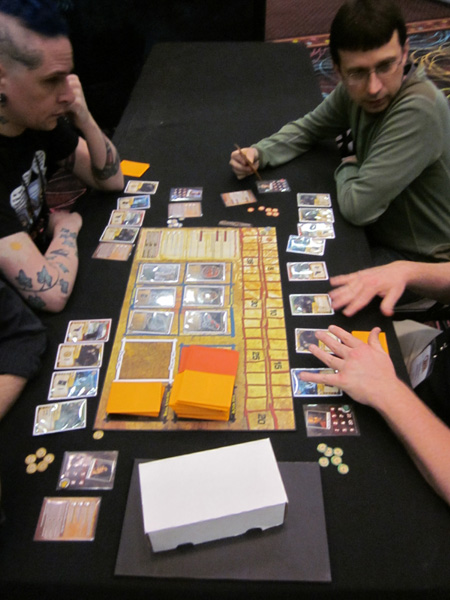


Friday, April 13, 2012

‘GLOOM OF KILFORTH: A FANTASY QUEST GAME’ - RULES VERSION 2.0

Finally they're here!  Nearly missed my own deadline too...


Please check for errors, grammar, and any other uncertainties and ask away here if you have any questions.  I've incorporated feedback from everyone who got back to me about the beta testing and have tried to cover everything that came up in the Living FAQ thread on this very site.

So thanks for all your help in getting the game this far and here’s to moving on to the next stage, with a sneak preview of the new Saga layouts below.  Here is the doc version of the rules:


Once it's all confirmed and checked over I'll transfer it to the full colour pdf and get that uploaded too.


Embeditin seems to have messed with the Word layout somewhat but hopefully it's all still legible...


Thursday, April 12, 2012

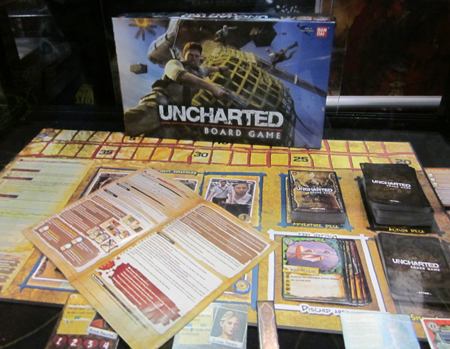
'Uncharted' Board Game From Bandai

ICv2 - 'Uncharted' Board Game From Bandai:

'via Blog this'

ICv2 have some details on the forthcoming Uncharted board game.  Looks more like a card game to me and I have to say the board looks depressingly unimpressive.  Coming from a line of PS3 titles I've been utterly addicted to I was expecting or hoping for something more, something beautiful.  Judge for yourselves below:


Wednesday, April 11, 2012

Fantasy Quest at UK Games Expo 2012

Hello Readers!


Just a little note to let you know that Mmzomba (Sam) and myself (Tristan by the way, nice to meet you) are booked in for Saturday and Sunday at the UK Games Expo 2012 and I’ve applied for a demo table on the Saturday too. Not sure if they have any left at this stage but if not I’m sure we can find a table or something somewhere. Otherwise it’s just going to be beers and browsing! So if anyone is going to be about it would be great to see you and maybe catch a game of Fantasy Quest too.  :)


Watch this space for the rules version 2.0 which will hopefully be released this week, along with the newly upgraded Saga cards...


Preview of Descent: Journeys in the Dark Second Edition

Fantasy Flight Games [News] - Gather Your Party:

'via Blog this'


Last year, we announced Descent: Journeys in the Dark Second Edition, the updated version of our classic dungeon-delving board game. This all-new presentation of the beloved title maintains the core experience fans enjoy – an epic semi-cooperative adventure in which brave heroes venture into dangerous caves, ancient ruins, dark dungeons, and cursed forests to battle monsters, earn riches, and attempt to stop the evil overlord from carrying out his vile plot. With its accessible rules and updated components, however, Second Edition remains deep enough for long-time veterans while inviting newcomers to join the adventure.
Today, we’re pleased to present the first in a series of previews of this upcoming release. First, we’ll offer a broad overview of what you’ll receive with Second Edition, which will lay the groundwork for more in-depth previews in the coming weeks. Then, we’ll see a few words from designer Adam Sadler in which he discusses the elements of Second Edition that excite him most.
A new take on classic dungeon-delving
Descent: Journeys in the Dark Second Edition is a board game in which one player takes on the role of the treacherous overlord, and up to four other players take on the roles of courageous heroes. Featuring double-sided modular board pieces, countless hero and skill combinations, and an immersive story-driven campaign, Descent: Journeys in the Dark Second Edition transports heroes to a vibrant fantasy realm where they must stand together against an ancient evil.
This updated version of the classic board game of dungeon-delving adventure features a host of enhancements, including new heroes and monsters, accessible rules, a class-based hero system, campaign play, and much more. In addition to its nearly 50 detailed plastic figures, 48 map tiles, nine custom dice, and much more, Second Editionoffers a comprehensive Quest Guide with 37 original maps.
What exactly does that mean? Take a look at the game layout above. This introductory setup, entitled First Blood, is a single-map quest designed to get players acclimated with Second Edition. Typically completed in about 45 minutes,First Blood pits the heroes against a rampaging ettin (a man-eating, two-headed giant) and his goblin minions.
First Blood is unique among Second Edition’s quests in that it consists of a single “encounter”; other quests are made up of two linked encounters, which are meant to be played back-to-back in a gaming session of just under two hours in length. So getting back to the Quest Guide’s 37 maps, they consist of one introduction, 17 two-part encounters, and two possible interludes (longer maps that divide the narrative at its halfway point). All together, Second Edition offers enough content to ensure years of replayability!
Also noteworthy is that each quest (again, consisting of two encounters) can stand alone, or work as part of a larger campaign narrative. This close interrelation between maps is just one of the ways in which Second Edition shines; the outcome of the first encounter of a quest affects the setup of its second encounter. Did the heroes manage to save any villagers in part one? Is so, those same villagers may become useful allies in part two.
Extending this concept to campaign play is another matter. Second Edition features an engaging “plot tree” system that presents different encounters depending the heroes’ victories and defeats. Keep reading for Second Editiondesigner Adam Sadler’s insights on the game’s immersive and adaptive campaign system, plus the increased strategic options of the overlord!
A word from the overlord
As a longtime fan of Descent: Journeys in the Dark, I was thrilled to get the chance to design Second Edition. Overall, the biggest challenge the design team faced was updating certain elements of the game while still staying true to the vision of the original. Right out of the gate, I knew that campaign play had to be a major element. While we wanted to maintain players’ ability to fully enjoy the Descent experience in single, self-contained sessions, it was equally important to include options for long-term character development and wider narrative arcs.
This brings me to the first aspect of Second Edition that I find most engaging. To keep campaign play interesting and varied, players will not always experience the same quests, or experience them in the same order, when playing through The Shadow Rune (the included campaign) multiple times. In fact, there is a well developed narrative driving the campaign that can branch off in different directions. Depending on whether the heroes or the overlord win certain quests, the players can actually influence how the overarching plot plays out. This brings a sense of light roleplaying to Second Edition, while giving players a feeling of ownership over their heroes’ fates.

A pad of these campaign tracking sheets is included with 
Second Edition,
allowing players to record the winning team for each quest. In addition to
determining what the next quest will be, this record helps establish other, more
subtle narrative factors throughout the campaign.
Another element of Second Edition that I think players will appreciate is the enhanced role of the overlord. I wanted to ensure that the overlord player would have plenty of compelling choices to make during a game.
Like the hero players, the overlord can choose a class in which to specialize, and he can customize his overlord deck to better suit his play style. The different overlord classes allow the overlord player to focus his tactics in the areas he wants. This deck customization creates a very different play experience for both the overlord player and the hero players; the overlord can change his tactics as he goes and the heroes won’t know what to expect!
Working on Descent: Journeys in the Dark Second Edition has been a challenging and enjoyable experience for me. I look forward to fans of the first edition getting a chance to try the new game, as well as seeing newcomers begin their own adventures.
Thanks, Adam! With Second Edition’s momentous release on the horizon, we’ll be ramping up our web coverage. Check back often for more, and prepare to enter the dungeon this summer!

Tuesday, March 27, 2012

Sneaking Past The Watcher in the Water, Part One


From the original FFG article here:

“The road must be trod, but it will be very hard. And neither strength nor wisdom will carry us far upon it. This quest may be attempted by the weak with as much hope as the strong. Yet such is oft the course of deeds that move the wheels of the world: small hands do them because they must, while the eyes of the great are elsewhere.”    –Elrond, The Fellowship of the Ring
Through The Redhorn Gate and along the Road to Rivendell, Arwen and the heroes of Middle-earth have been taxed nearly to their limits by snowstorms, perilous mountain passes, and wave after wave of ferocious ambushes. Now, at long last they have arrived safely at the Last Homely House. Though some of the heroes may hope their journeys through the Dwarrowdelf have come to an end, the truth is that they’ve only just begun.
Elrond, the master of Rivendell, is troubled by the great numbers of Orcs that once again infest the Misty Mountains. Many years have passed since the Orcs posed such a threat, and their return is troubling. Accordingly, Elrond asks the heroes of Middle-earth to explore the mines of Moria for the source of the increased Orc activity. But before the heroes can explore Moria’s vast network of tunnels, they must first gain entrance…
Beneath the gaze of the great
As we look forward to the release of The Watcher in the Water, the third Adventure Pack in the Dwarrowdelf cycle for The Lord of the Rings: The Card Game, we’ll take a close, practical, three-part look at the game’s new Secrecy mechanic, concluding with a deck list featuring the pack’s new hero.
While we’ve already learned how the mechanic works in an article on deck-building and received design insights in apreview of The Redhorn Gate, these haven’t been “practical” explorations of the mechanic. Why? The game hadn’t yet reached the critical mass of Secrecy cards and effects to make a Secrecy deck viable. The Secrecy cards introduced with the first two Dwarrowdelf Adventure Packs may present some excellent, cost-effective benefits for players who can keep their threat at 20 or below, but they don’t, on their own, offer enough reward to encourage decks built specifically to take advantage of Secrecy discounts.
That may change with The Watcher in the Water. This Adventure Pack introduces only one new card with the Secrecy keyword, but it bolsters the strategy with a number of exciting new cards that provide the card draw, resource acceleration, and threat manipulation that Secrecy decks need.
The aid of the Last Homely House
The master of Rivendell and his daughter lend their aid in The Watcher in the Water. Elrond lends your heroes his counsel before they set forth into the wild, and Arwen Undómiel (The Watcher in the Water, 58), having just traveled with the heroes across the Misty Mountains, offers to travel with them once more as an ally.
Though Elrond’s Counsel (The Watcher in the Water, 59) may soon form a core component of most Secrecy decks, it can easily fit into any deck with a Spirit hero. For the cost only of the card draw, Elrond’s Counsel both boosts a character’s Willpower by one and reduces your threat by three. Threat reduction is always good, and additional Willpower is always welcome, too.
Elrond’s Counsel put to the test
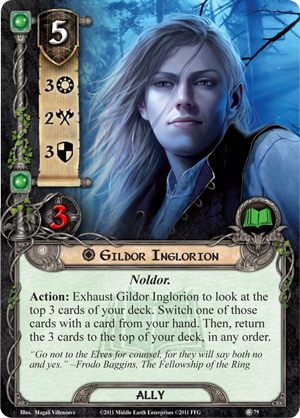
So what’s the catch? First of all, you need to control a unique Noldor character. While the new Arwen ally happens to be a Noldor from the Spirit sphere, she’s the only one. The only Noldor characters currently in the game include her brothers Elrohir (The Redhorn Gate, 1) and Elladan (Road to Rivendell, 28). They belong, respectively, to the Leadership and Tactics spheres. Then, there are only two more unique Noldor characters, Glorfindel (Core Set, 11) and Gildor Inglorion (The Hills of Emyn Muil, 79). This means the most reliable way to receive the benefits of Elrond’s Counsel is to start the game with a Noldor hero paired alongside a Spirit hero. Since the majority of the game’s Secrecy cards currently belong to the Leadership and Lore spheres, a two-hero Secrecy deck might be able to make good use of either Elrohir or Glorfindel.
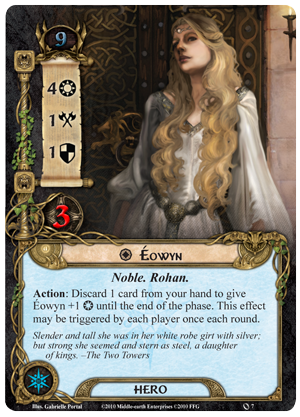
Pairing Elrohir with a character like Ã‰owyn (Core Set, 7) means you start both with considerable Willpower to apply toward the quest, as well as the ability to ready a defender to attack. Elrohir’s Leadership icon allows you to make use of the fantastic event, Timely Aid (The Redhorn Gate, 3), and though it’s true Elrohir doesn’t have the greatest Defense Strength without Elladan in play, it’s still possible to bolster his defense with Dúnedain Warning (Conflict at the Carrock, 26) and Arwen’s ability.
Alternatively, you could pair Glorfindel with Frodo Baggins (Conflict at the Carrock, 25) or Dúnhere (Core Set, 9), either one of whom grants extra action potential, either by soaking wounds as threat and releasing you from the need of assigning a defender in certain situations, or by attacking enemies in the staging area, releasing you from the need to defend them. Meanwhile, the Lore sphere benefits from such Secrecy cards as Needful to Know (The Redhorn Gate, 9) and Out of the Wild (Road to Rivendell, 36).
If you build the right support into your deck, any of these starting fellowships provides you the means to push forward on your quest – all while remaining beneath the notice of most enemies. Your enemies might build up in the staging area, and you’ll need to confront them eventually, but if you adopt a good measure of Secrecy and heed Elrond’s Counsel, you should be able to recruit enough allies to your cause to deal with the enemies when the time is right.
Thus ends the first part of our look at how Secrecy hits critical mass in The Watcher in the Water. Check back over the next couple weeks for more previews and a Secrecy-focused deck list!

Monday, March 26, 2012

Lords of Waterdeep - NinjaDorg gets his arse kicked

Her irony loaded words filled me with a heady mixture of expectation management but also pride:

“Okay then, let’s get this boring board game over with so we can watch another episode of The Walking Dead.”

My wife is not a gamer. Not by any stretch. And I wouldn't have it any other way. She kind of benignly sees my board game addiction as a much more preferable alternative to me getting sloshed down the pub every Saturday watching footie with the lads. So once every blue moon she’ll indulge me when a new title lands and I can’t wait until Thursday game night to break it out.

After struggling to resist a nebulous magnetism in Merric’s early preview reports on Lords of Waterdeep - and failing miserably it has to be said - I pulled the trigger on an Amazon pre-order. When Lords of Waterdeep arrived at my FLGS and sat there taunting me after Amazon had said it would be two more weeks before delivery, I paid the extra few quid and picked up a copy of LoW there and then, and cancelled my Amazon pre-order.

As an ardent Brit-trasher I’d been looking for a decent Euro for a long time and the theme of this one was irresistible. Especially considering the many hours of my youth I’d given over to travelling this imaginary city or indeed hosting adventures in it. Or reading books about it. Yeah Waterdeep figures pretty heavily in that respect. So when I laid out the map board for this new game I got a weird nostalgia rush for the old City System Waterdeep boxed set, and an old AD&D campaign I ran where the players invaded the city’s keep. Great days.

Well here we were now fighting to save the city and exercise control over it. My wife was blissfully oblivious to all of this back story of course, it was just coloured cube gathering and card playing. I ran through the simple rules quickly and dealt out the Lord cards, then had an ‘oops’ moment. I’d drawn Larissa Neathal – the one ‘different’ Lord who gives bonus points for Buildings at the end of the game.

“So you’ll see you’ve got two types of quest there that you need to aim for without telling me what they are. Oh, and by the way there’s also a Lord who gives bonuses for building buildings too, just so’s you knows...”

I briefly mulled over the consequences of beating her mercilessly by just buying buildings the whole game whilst she struggled for quests. Well if off the back of that she decided never to play again we’d always have Forbidden Island (which went over quite well that one time we played it all those months ago) or, um, Walking Dead season 2. In any case it was her first game of LoW but I decided not to hold back as it was my first game too.

As first player I* decided to try and grab gold to get some buildings going, so I popped a little wooden dude down at Aurora’s and added four gold to my supply.

With her first move she bought a building.

D’oh!

Okay, not a problem, there are seven more rounds to go yet, and other ways to get buildings too.

As the game moved swiftly on we took turns to place our little guys and grab coloured cubes and the ‘theme’ of the game slipped away pretty quickly – I still don’t know which coloured guys are which. Although the fighters all inexplicably wear orange iirc. Basically, it may as well have been a bunch of farmers and sheep, though I probably would not have bought the game if it were...

My wife was completing an alarming number of quests, and especially plot quests, and seemed to somehow be getting cubes faster than I could. Her VP token was ahead of mine for the whole game and I realised I still needed to complete regular quests to win. As I focussed on questing she handily yoinked the first player token from me and kept it for the rest of the game.

So I hit her back with a few intrigue cards as and when I could to keep her in check.

“Bam - give me your purple cube!”

Then she started to hit me back with her own intrigue cards, nicking my guys and plopping annoying mandatory quests on top of me.

“Bam yourself – stop being a dick!”

Suddenly it was round 5 and our fifth agents came into the game – time was really flying. I only had a couple of buildings and gold was hard to come by, so I focussed almost exclusively on dominating the Builder’s Hall. As I got increasingly desperate for effective moves she seemed to be breezing through and completing quests which had really big requirements and gave really big rewards. Soon she had her 100 VP token whilst I straggled behind. I took solace as I put the finishing touches to my fifth building, completed another quest and passed the 100VP mark myself. I decided my game would come together in the final scoring stages.

Soon enough the game did come to an end in under an hour and we totted up the final scores. I made a sort of ‘sorry’ face as I revealed my Lord, explained her bonus and bounced along the VP track, over-taking her marker and landing on 139 total Victory Points for the game. Un-phased she revealed her own Lord: Durnan the Wanderer, whose principal interests were Commerce and Warfare. For dramatic effect she revealed her quests one by one. Every single one of her completed quests had been Commerce or Warfare. She hopped along the VP track and landed on 141 Victory Points!

I checked and re-checked the final scores about four times and realised with growing trepidation that I had just been soundly and thoroughly arse-whupped.

“That wasn’t bad - it was a bit like Forbidden Island, not one of those long boring ones you always play. Shall we go and watch the season finale then?” she smiled.

I need to step up my skills before game night on Thursday!


Some notes on Lords of Waterdeep...

Pros:

The box is great, the insert is fantastic – probably the first insert that I will not throw away. You can turn the box upside down and shake it about and everything stays in place (except for the 100VP tokens, no big deal though).

Cards seem great, the linen texture is fine, another game that I don’t think I’ll need to sleeve any time soon, which is nice. Plus they have artwork on the cards! After the disappointingly bland D&D Adventure System games’ cards this was a lovely step up in quality.

The layout of the game feels very organic, it’s easy to see what goes where on the map and the map itself is good. Although fairly colourless it serves its purpose beautifully and speeds the game up too.

The gameplay is easy to pick up, we didn’t have any rules questions in this first play, and it goes by very quickly.

The art for the locations is really nice, and the players’ Tavern cards look sweet.


Cons:

Generally, the art itself is not really great however. I’d have loved to see some of the old 1st and 2nd edition D&D art recycled for this, or just good art generally in that style. But it’s all very cartoony and Magic: The Gathering-y. In fact my wife was crying laughing at Durnan’s ugly mug but couldn’t tell me why she was laughing until after the game finished. In fact pretty much all of the characters are quite ugly. Even the pretty ones. FFG has spoilt us in this respect.

Wooden cubes! I don’t see the attraction, or the need, or the why, or the how. They’re supposed to be people? I don’t get it!!! Surely potential Euro gamers attracted to the wooden cubes will be put off by ‘Dungeons & Dragons’ written on the cover! Even the agent meeples look a bit dumb. But they stand up well and are durable as hell.

The theme is nice and everything - it's what drew me in after all - but it's a struggle to keep it in your head as you play. For example, you'll be much more concerned about how many oranges and whites you have and how many blacks and purples you need.


Finally:

I really enjoyed Lords of Waterdeep and it sped by at a great pace. I can’t wait to break this out with my group and see how they take to it. Might even be able to get my wife to play again some time...


* what? it’s not an etiquette thing, I’d just got back from a shoot in London, it’s in the rules dammit, whoever went to another city most recently goes first!! 

Wednesday, March 21, 2012

Dungeons & Dragons Official Home Page - Design Article (Lords of Waterdeep)

Lords of Waterdeep
Design & Development
Rodney Thompson and Peter Lee


Dungeons & Dragons Roleplaying Game Official Home Page - Article (Lords of Waterdeep):


'via Blog this'


ords of Waterdeep is a new strategy board game set in the world of Dungeons & Dragons, debuting this month. In this Euro-style game, players send off their Agents to recruit Adventurers and recruit Quests. In this article, designers Rodney Thompson and Peter Lee describe the prototyping process and how the early, simple prototypes evolved into the high-end board game you can find in stores now.

Prototype Design

Rodney: Today we want to talk a little bit about the prototyping process for Lords of Waterdeep, and give you an idea of just how far the game has come from those early days.
One of the most important things I've learned from the process of working on Lords of Waterdeep is that, until it's time for the game to go to press, you should focus most of your efforts on perfecting the game's design. Function beats form during design and development, and our early prototypes really reflected that.
Our very first prototype consisted of an 8" x 10" dungeon tile covered in stickers, several 4" x 4" dungeon tiles with stickers on them for the Buildings, a bunch of Star Wars and D&D miniatures for the Agents, and the scoring track from Carcassonne to monitor our scores during play. Our card decks made by layering stickers over foreign language Magic and Duel Masterscards. To say it looked "cobbled-together" would be putting it nicely. However, I think this lack of polish early on actually helped a lot in that we never got too attached to the design's physical form.
Pete: When we started work on Lords of Waterdeep, I was playing weekly board games with my Dungeon Command co-designer Kevin Tatroe and his family. Earlier in the year, they gave me a gift from a local teacher supply store, a box of one thousand plastic cubes in ten different colors—a prototyper's dream! These became the Adventurers we needed for the game. I also had a supply of yellow tokens that we used for Gold.
Rodney: In this first prototype, we used red cubes for Rogues (because Rogues create blood splatters), black cubes for Fighters, green cubes for Clerics, and blue cubes for Wizards. Now when we play the finished game, Peter and I both still sometimes mix up Rogues and Fighters, because Fighters were represented by black cubes for so long that it became ingrained in our minds.


Rodney: That first game was playable to completion and, despite the speed with which the eclectic collection of prototyping materials had been put together, we were able to jump right into the iterative design process. As I mentioned earlier, not getting too attached to the game's components was very, very important to iteration. When Peter or I would make a suggestion for how to fix something, we'd take a pen and write on the sticker immediately, and then play with the change. In my mind, that kind of rapid iteration is critical to the design of a board game, and one of the reasons the Waterdeep design and development process went so well.
So, if there's some advice I'd give to any budding board game designers out there, it's to save the fancy prototype design for after your game is done. You need to be able to write on everything, change rules on the fly, and be ready to throw out entire groups of components if need be, so don't spend too much time making things pretty.
Pete: We knew we had a kernel of a good game, but we had a long way to go. For the next version of the game board, I was interested in usability. In a perfect world, the game board has enough visual cues that you can look at it and understand how to play. While such an ideal is nearly impossible for a game with any complexity, I still wanted to get as close as possible.
Rodney: In fact, one test I ended up putting the board through near the end of the process was to take the board, show it to a friend who was a board gamer but had not yet played (or even seen) the game, and asking him to tell me how he thought the game played. Based on his reactions, I was able to make some slight tweaks to the board to make sure the game board communicated to the player more intuitively. Thanks to the work Peter put in at this stage of the process, my friend was able to guess about 80% of the game play just by looking at the board, which was a great start.
Pete: Rodney and I also discussed how we imagined the board. We both wanted an isometric view of the city. I found a map of Waterdeep from the 3rd Edition Forgotten Realms Campaign Setting, photocopied it, and taped it to the back of half anAxis & Allies board.
I quickly constructed board elements on the computer and printed them out. Using the highly technical skills I learned back in kindergarten, I created the second board.


This is the board we played on the most. The elements were all attached by tape, making it easy to update and modify after each game. Working on this board taught us a lot about how the components needed to be laid out for the best play experience.
  • Quests for drafting needed to be at the top to make it easier for the players whose spot at the table might force them to read cards upside down.
  • Basic and Advanced Buildings needed be close together to make it easy to see all the available actions.
  • The Quest-drafting Building needed to be close to the Quests.
  • Likewise, the Building-drafting Building needed to be close to the Buildings that could be purchased.
  • The turn tracker needed to be near the Buildings availabl to be purchased.
  • For story reasons, the basic Buildings needed to be located in approximately their canonically correct places in the city.
Rodney: Around this time we were also starting to consider color issues. Color blindness is something we wanted to be aware of in the design of the game, so we needed to get rid of the green color for Clerics (a color that many color-blind people have difficulty distinguishing from shades of red). Likewise, we knew at this point that having our Agents (and, thus, Faction colors) the same color as some of our Adventurer resources was problematic; sometimes people would lose track of their Agents when Adventurers of a similar color were nearby. That's why, in the final game, only one Faction shares its color with an Adventurer color.
Pete: We were getting ready to start discussions with our graphic production team, so it was time to take all the things we learned from this version and update the board. So far, both Intrigue cards and Quest cards were handled in a landscape form. This worked great for the Quests, but it didn't make as much sense for the Intrigue cards since you hold them in your hand. We decided to change the orientation of the card.
At 14.5 inches by 19.5 inches, this board was too small. We were still using the separate Carcassonne board to keep score. Purchased Advanced Buildings sat on the side of the board, putting them a short distance from the central Building squares. Quest cards sat above the board.
A lot of space was taken up by having the resources on the board. It made round preparation easier as all the players could help move resources to the proper Building spaces. Each yellow arrow showed how many cubes needed to move. When we decided to remove the resource accrual mechanic, it was time to design the next major board iteration.


The new board increased to about 20 inches by 24 inches. Everything that we wanted on the board now fit. We brought in art director Keven Smith to work on the final version.
Rodney: I can't say enough good things about the work Keven did taking out primitive prototypes and transforming them into something visually impressive. One of the first things Keven did for us was to create a "wire frame" version of the board, which had the action spaces, blank spots for Buildings, and so forth, but contained no art and only some very limited graphic design. This was a critical step in the prototyping process, despite actually being a step in the game's graphic design process; because we were able to take the wire frame and play on it, we were able to quickly identify any areas that would produce an unsatisfying or unclear experience. We could move different action spaces around, and it was at this time that we started matching up action space names with city locations, which further helped us figure out where to place things. For example, Aurora's Realms Shop was placed where it was to continue the circular arc of basic resource spaces that starts with Blackstaff Tower and moves clockwise around the outer areas of the city, creating a better information flow for where to find basic resources.


As we reached the end of the design process, we had to make some decisions about what our final components would be. Peter and I discussed it and decided that we wanted wooden pieces for the game, specifically cubes for the Adventurers, because we were trying to create a specific type of experience. Fans of strategy board games (aka Euro games) are accustomed to high quality games having wooden pieces, and we wanted to deliver components that met their expectations. For our Agents, Keven's team managed to create a shape that evoked the human form (that of your Agent moving out into the city) that also was exceptionally stable and had some heft to it, so that it was unlikely to tip over during play or be lost while setting up or putting away the game. From there, all that remained was to convert our primitive cards into their final form, and then let Keven and his team construct the gorgeous game you see today.