Hall or Nothing Productions Ltd

Tuesday, April 24, 2012

Statistics are like a bikini. What they reveal is suggestive, but what they conceal is vital.

At the risk of being my nerdiest, most boring post ever (and there are some real contenders) I thought I’d share this with you all. I found this stat log of earlier games of Castle Ravenloft over the past couple of years - about 90 games’ worth (or approximately 4 days of solid gaming blush)! These are mostly before introducing our Complete Campaign Rules with event cards, etc and use 2 surges unless stated otherwise. Whilst some of you might be bored until you’re sick in the mouth I figured some of you might find it interesting so here goes – please excuse the disparate, scatty layout...


WARNING: You may snore


SOLO CASTLE RAVENLOFT ADVENTURE 1 - TOMB

1. Ranger: LOST – killed by zombie on 10th tile (careful, hunter, bounding, unbalancing)
2. Fighter: WON – 3hp + 1 surge, Sword +1, Crystal Ball & Wand +17xp (start skills)
3. Rogue: WON – faced Strahd on last tile, 1hp + 2 surges + lvl 2, Boots, Amulet + 5xp
(start skills)
4. Cleric: WON – faced Strahd, 1hp + 2 surges, Wand, Avenger, Tools, Amulet, Holy Water +13xp (start skills)
5. Wizard: WON – 1hp + 0 surges, Ring, Tools, Sword, Amulet +12xp (start skills)
6. Ranger: WON – 2hp + 1 surge, Tools, Amulet +8xp (Careful, Hunter, Split Tree, Parry)
7. Ranger: WON – 3hp + 0 surges, 3 Items, lvl 2 + 3 xp 
8. Fighter: LOST – killed by Strahd on penultimate tile, Sword, lvl 2, 0xp
9. Rogue: WON – 1 surge, Wand, 2 Rings, Charm, lvl 2 + 7xp

CUSTOM HEROES:

10. Samurai: LOST – found stairway, all monsters in play, Alarm Trap
11. Samurai: WON – lvl 2, 0 surges, 8hp + 3xp, Sword, Amulet
12. Ninja: WON – 0 surges, 1hp + 9xp, Boots
13. Bard: LOST – 4 tiles away from finding the stairs!
14. Avenger: WON – 0 surges, 5hp + 1xp, Charm

15. * Ranger WON – lvl 2, 1hp, 0 surges, 8xp, Tools, Sword CAMPAIGN * A2 ICON NEXT


SOLO CASTLE RAVENLOFT ADVENTURE 2 - ICON

1. Ranger: WON – 0 surges +21xp
2. Wizard: WON – 1 surge, lvl 2, Accuracy Ring, Protection Amulet, 8hp + 11xp
3. Cleric: WON – 2 surges, Necklace, Tools, 6hp + 3xp
4. Rogue: WON – 0 surges, 8hp + 10xp, Ring, Boots, Charm, Ward, Avenger
5. Fighter: LOST – 4xp, Boots, Crystal Ball, Holy Water
6. Fighter: WON – 1 surge, 10hp + 4xp, Glyph

CUSTOM HEROES:

7. Barbarian: WON – 2 surges, lvl 2, Sword, Glyph, 12hp + 2xp
8. Paladin: WON – 1 surge, lvl 2 Sword, Amulet, Glyph, Ring, Wand, 8hp + 13xp
9. Warlock: LOST – 3xp, Tools, Holy Water, killed by Fire Trap
10. Assassin: LOST – 0xp, lvl 2, Amulet, killed by Strahd’s Hunger
11. Assassin: LOST – 2xp, killed by Wraith
12. Assassin: LOST – 3xp, Amulet, Avenger, killed by Blazing Skeleton
13. Assassin WON – 0 surges, 7hp + 4xp, lvl 2, Sword, Necklace, came back from 1hp!
14. Warlock: WON – 12xp, Boots, Crystal Ball, Ring, lvl 2, 1 surge + 8hp

15. * Ranger WON – lvl 2, 10hp, 0 surges, 15xp, Tools, Sword, Avenger, Used ICON CAMPAIGN * A3 KLAK NEXT


SOLO CASTLE RAVENLOFT ADVENTURE 3 - KLAK

1. Fighter: LOST – Avenger, Amulet + 22xp, Klak on 5hp (of 6)
2. Ranger: WON – 0 surges, 1hp (!) + 0xp, no treasure left (lost Regeneration Ring)
3. Cleric: WON – 2 surges, 2hp + 4xp, lvl 2, Striding Boots, Regeneration Ring
4. Rogue: LOST – Accuracy Ring, Avenger + 4xp, 1 turn from certain victory!
5. Wizard: WON – 0 surges, 2hp + 6xp, lvl 2
6. Fighter: LOST – Regeneration Ring, beat Klak but not machine, killed by Blazing Skeleton
7. Rogue: LOST – Sword + 2xp, beat Klak, 1 turn from destroying machine, killed by Spear Trap
8. Fighter: WON – 0 surges, 1hp (!) + 5xp, 1 turn from certain failure!
9. Rogue: LOST – Protection Amulet + 3xp, Killed by Patrina before even finding lab!
10. Rogue: LOST – Avenger, Protection Amulet + 2xp, beat Klak but not machine,
killed by Cackling Skull
11. Rogue: LOST – 10xp, Amulet, Boots, Klak on 1hp
12. Rogue: LOST – 4xp, Regeneration Ring – used 3 surges!
13. Rogue: LOST – 0xp, beat Klak, machine on 1hp – used 4 surges!
14. Rogue: WON (finally) – 1hp + 0xp, Protection Amulet, used 3 surges

15. * Ranger WON – lvl 2, 4hp, 1 surge, 21xp, Tools, Sword, Avenger, Amulet, Boots CAMPAIGN *


SOLO CASTLE RAVENLOFT ADVENTURE 5 - KAVAN

1. Cleric: WON – 0 surges, 4hp + 6xp, lvl 2, Avenger, Boots, Tools, Charm, Amulet
2. Fighter: LOST – 7xp, Kavan on 3hp
3. Fighter: WON – 0 surges, 4hp + 3xp, Sword, 2 Charms
4. Ranger: LOST –6xp, Sword, died 6 tiles in!
5. Ranger: WON – 2 surges, 2hp + 17xp, lvl 2, Avenger, Sword
6. Rogue: LOST – 10xp, lvl 2, Sword, Ring, Kavan on 2hp
7. Rogue: WON – 0 surges, 4hp + 5xp, Sword, Boots, Amulet
8. Wizard: WON – 1 surge, 3hp + 3xp, lvl 2, Regeneration Ring


SOLO CASTLE RAVENLOFT ADVENTURE 6 - DRACOLICH

1. Wizard: LOST – 0xp, Sword, Boots, Gravestorm on 20hp!
2. Ranger: LOST – 8xp, 7 Items, Gravestorm on 4hp!
3. Cleric: LOST – 6xp, Necklace, Gravestorm on 12hp
4. Fighter: LOST – 1xp, Wand, Gravestorm on 14hp
5. Cleric: LOST – 2xp, Regeneration Ring, Gravestorm on 4hp
6. Ranger: LOST – 1xp, Gravestorm on 1hp! Accuracy Ring, Protection Amulet, Necklace
7. Ranger: LOST – 2xp, Wand, Gravestorm on 1hp!
8. Ranger: LOST – 8xp, Scroll, Gravestorm on 20hp and not even found yet!
9. Ranger: LOST – 2xp, Gravestorm on 20hp and not even found yet!
10. Ranger: LOST – 25xp, Wand, Boots, Crystal Ball, Holy Water, Gravestorm on 20hp

11. **Cleric: WON – 2 surges, 4hp, 11xp, lvl 2, Protection Amulet, Holy Water CAMPAIGN ** A8 HAG Next


SOLO CASTLE RAVENLOFT ADVENTURE 7 - IMPOSSIBLE

1. LOST – beat Golem and Vampire but killed by Werewolf (is he invincible against solo?)
2. WON – Fighter and Cleric killed against Hag and Vampire, Rogue went on to finish Werewolf (not invincible then!)


SOLO CASTLE RAVENLOFT ADVENTURE 8 - HAG

1. Fighter: LOST – 9xp, Hag on 1hp, 5 Time Tokens
2. Ranger: WON – 1 surge, 1hp, 2xp, lvl 2, Regeneration Ring (unused)
3. Fighter: LOST – 2xp, Hag on 3hp, 0 Time Tokens
4. Fighter: WON – 0 surges, 4xp, lvl 2, 5hp, Holy Water x2

5. ** Cleric lvl 2: WON – 7hp, 6xp, 0 surges, 1 power, continued from A6 Dracolich, Amulet Protection CAMPAIGN **


2 PLAYERS ADVENTURE 2 - ICON

1. WON: Cleric (Sam): WON 0 Surges, 4hp Accuracy Ring, Wand, Boots +10XP (start skills)
Fighter lvl 2 (ND): Brute Strike, Regeneration Ring, Sword, Amulet
2. Rogue (Bob) + Ranger (ND): LOST – reached Chapel
3. Wizard (Bob) + Ranger lvl 2 (ND): WON – 10xp, Sword, Avenger, Icon
4. Fighter (Kris) + Wizard (ND): LOST – 0xp, died at the Chapel


2 PLAYERS ADVENTURE 3 - KLAK

1. Rogue (Sam) + Ranger (ND): WON
2. Wizard (Bob) + Ranger (ND): LOST – 4xp, Avenger, Ring, Wand, Klak dead, Machine: 2hp
3. Cleric lvl 2 (Bob)+ Ranger (ND): LOST – 2xp, Boots, Tools
4. Fighter (Ant) + Wizard (ND): LOST – 6xp, Necklace, Sword, Crystal Ball
5. Ranger (Wife) 3hp + Cleric (ND) 3hp: WON – 10xp, 2 surges


2 PLAYERS ADVENTURE 4 - ASSAULT

1. Cleric (Sam) + Fighter lvl 2 (ND): LOST 10 Items, 0xp


2 PLAYERS ADVENTURE 8 - HAG

1. Fighter (Sam) 2hp + Ranger (ND) died: LOST 4xp, 0 time tokens, Hag on 3hp
2. Cleric (Sam) died + Wizard (ND) died: LOST 0xp, 0 time tokens, Hag on 2hp
3. Cleric (Sam) 1hp + Ranger (ND) 4hp: WON 1 surge, 2xp, Accuracy Ring, Tools, H Potion


3 PLAYERS ADVENTURE 2 - ICON

1. Ranger 7hp (Sam) + Ranger 9hp lvl 2 (Dan) + Wizard 3hp (ND): WON - 7 xp + 2 surges#
2. Rogue (Ant) + Ranger (Wife) + Cleric (ND): WON – 0 surges, 2 XP
3. Ranger (ND) 2hp + Cleric lvl 2 (Ant) 5hp + Wizard (Bob) 3hp: WON – 0 surges, 4 XP


3 PLAYERS ADVENTURE 5 - KAVAN

1. Ranger 6hp (Sam) + Ranger 5hp lvl 2 (Dan) + Wizard 5hp (ND): WON - 14xp + 2 surges
2. Fighter lvl 2 (ND) + Ranger (Ant) + Cleric lvl 2 (Bob): LOST – 0 surges, 5 XP, Kavan on 3hp
3. Assassin (Ant) 0hp + Fighter (Dan) 3hp + Ranger (ND) 0hp: LOST – 0 surges, 1 XP
4. Assassin (Ant) 6hp + Fighter (Dan) 1hp + Ranger (ND) 3hp: WON– 1 surge, 5 XP


3 PLAYERS ADVENTURE 6 - DRACOLICH

1. Ranger 2hp (Sam) + Ranger 6hp (Dan) + Wizard 1hp (ND): WON - 3 xp + 0 surges
2. Ranger (ND) 0hp + Cleric lvl 2 (Ant) 3hp + Wizard (Bob) 3hp: LOST – 0 surges, 2 XP
3. Fighter (ND) 1hp + Ranger (Ant) 0hp + Cleric lvl 2 (Bob) 0hp: WON – 0 surges, 2 XP, Holy Water, Regeneration Ring, Sword


Quick Observations:

For solo single hero play the first 8 Adventures are pretty well balanced, except for the huge drop off with Adventure 6 - the Dracolich Adventure. My only victory against it was using the Cleric, who levelled up and then went on to play a successful two adventure ‘campaign’.

The Werewolf can really screw a solo Hero over if you don’t have boosted damage powers, potentially becoming invincible.

Castle Ravenloft does seem easier with more players, but it probably balances out on the whole, depending which characters you pick. Which brings us to...

The Rogue is still awfully weak. The worst Hero in the series. Luckily the Rogues from Drizzt and Ashardalon are much cooler.

Friday, April 20, 2012

Descent: Journeys in the Dark Second Edition New Preview


Descent: Journeys in the Dark Second Edition, the updated version of our classic dungeon-delving board game, is coming this summer! This all-new presentation of a beloved title maintains the core experience fans enjoy – an epic semi-cooperative adventure in which brave heroes venture into dangerous caves, ancient ruins, dark dungeons, and cursed forests to battle monsters, earn riches, and attempt to stop the evil overlord from carrying out his vile plot.
Last time, we saw an overview of what’s included in Second Edition’s Quest Guide, and we heard from its designer, Adam Sadler. Today, we’re pleased to present an in-depth preview of the anatomy of Second Edition’s all-new Hero sheets, leading into a discussion of some of its exciting new gameplay elements.
A hero of the wilds
A master of the bow and fearless defender of nature, Jain Fairwood stands ready to oppose the vile machinations of the overlord alongside her fellow heroes. Her speed and stamina give her the commanding ability to traverse nearly any terrain with ease, while her preternatural, almost animal-like awareness helps her detect hidden threats.

Jain Fairwood’s Hero sheet. Click to enlarge.
Take a look at Jain’s Hero sheet, above. Since her archetype is Scout, Jain will be able to choose from one of two classes: Thief or Wildlander (we’ll learn more about classes in future previews).
Aside from her name and portrait, you’ll likely notice three main sections: her characteristics in a column down the center, her attributes in the lower left corner, and her text effects on the right. While her Hero Ability (upper right) can be used any time its triggering condition allows, her Heroic Feat (lower right) is a special once-per-game ability that is "spent" by flipping her Hero sheet over. We'll explore Abilities and Feats in more detail throughout future previews; for now, let's focus on those numbers.
Fans of the first edition of Descent: Journeys in the Dark are already familiar with the purpose of a hero’s characteristics. Speed determines how many spaces a hero may move, Health is the amount of damage she may suffer before she is defeated, and Stamina represents the number of fatigue points she may “spend” on various benefits. It’s the fourth characteristic, Defense, that signifies the first major difference between Second Edition and its predecessor.
The gray cube in that fourth circle represents Jain’s Defense characteristic, and it indicates that she rolls one gray die (a medium-level defense die) when attacked. As in the first edition of Descent: Journeys in the Dark, Defense is a means of deflecting incoming damage. However, Second Edition’s custom Defense Dice ensure that an attack can never be “mathed out” in advance, better reflecting the uncertain nature of personal combat.
The true test of heroism
This brings us to another major change introduced by Second Edition: attributes. In the lower left corner of Jain’s Hero sheet, you’ll notice four more statistics that serve a different purpose entirely. Unlike characteristics, attributes aren’t spent and don’t tend to change over the course of the game. Instead, they represent the core strengths of a character, and are “tested” to perform difficult maneuvers, resist special monster attacks, or avoid traps played by the overlord.
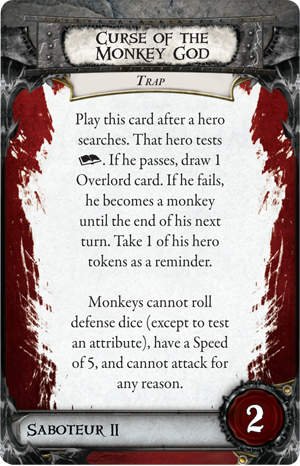
From left to right, Jain’s attributes are WillpowerMightKnowledge, and Awareness. These versatile stats underscoreSecond Edition’s focus on compelling narratives; a scenario might call for a test of Might to move a boulder blocking a path, or a test of Awareness to avoid an ambush by sinister goblins. Even new versions of classic Overlord cards likeCurse of the Monkey God depend on a character’s attributes. This underhanded spell can only be resisted by a display of superior intellect, represented in-game by a Knowledge test.
With a Knowledge attribute of only three, Jain may be in a bit of trouble if the overlord targets her with Curse of the Monkey God. To test an attribute, a player simply rolls one gray defense die and one black defense die. If he rolls a number of shield icons equal to or less than his hero’s applicable attribute, he passes. Can Jain roll low enough, or will she spend her next turn swinging from the rafters by her tail?
Acting heroic
Now that we’ve examined a hero, let’s take a look at what heroes do each turn. As we’ve mentioned previously, one of the goals in developing Second Edition was to make the game more accessible. This shows not only in how information is presented on the game’s components, but in the intuitiveness of its mechanics. For example, rather than having to consult the rules to determine movement point costs, players can keep this simple rule in mind: On each turn, your hero can perform two actions.
What are these possible actions? As a constant reminder, they’re printed on your Activation card, which is situated in front of you during the game (it’s this card that you flip to indicate your hero has acted in a given round, and the other side lists the Overlord’s Turn Summary). On each turn, your hero will perform some combination of two of the following (or may even perform the same action twice):
  • Move a number of spaces equal to his Speed.
  • Attack a monster.
  • Use a skill that’s marked as an action.
  • Rest, recovering all fatigue at the end of his turn.
  • Search an adjacent space containing a search token.
  • Stand up if he’s been knocked out. This is the one and only action that a knocked out hero may perform.
  • Revive an adjacent hero who has been knocked out.
  • Open or close an adjacent door
  • Perform a special action, as defined by the scenario
Now that we’ve seen a broad overview of how heroes function in Descent: Journeys in the Dark Second Edition, we’ve set the groundwork for a series of more in-depth previews in the coming weeks. Check back often as we go into detail on some of the actions listed above, the different classes of heroes and their unique skills, the powers of the vile overlord, and much more.
And remember, the Descent: Journeys in the Dark Conversion Kit offers forty-eight Hero sheets, three Familiar cards, and fifty Monster cards that allow you to use your first edition plastic in Second Edition! Curious about how your favorite classic hero will be portrayed? Follow us on Facebook, where beginning tomorrow, we’ll reveal a converted classic Hero sheet from the Descent: Journeys in the Dark Second Edition Conversion Kit each week. You can even vote on which classic character we’ll spoil next!

Thursday, April 19, 2012

Mage Knight card errata

The first printing of the Mage Knight board game had some issues.  One of these was the incorrectly printed cards pointed out in the rulebook.  Luckily BGG user Paul Grogan has uploaded scans of the corrected cards, so for those of us hardcore fans who bought the game early but were abandoned by Wizkids for replacements you can now download them here:


Or this should work if you're printing to A4, just download the full size image:


Something Tookish Woke Up


“The hobbit felt the love of beautiful things made by hands and by cunning and by magic moving through him, a fierce and jealous love, the desire of the hearts of dwarves. Then something Tookish woke up inside him, and he wished to go and see the great mountains… and explore the caves, and wear a sword instead of a walking-stick.”
    –The Hobbit

We recently had the privilege to announce the upcoming release of The Hobbit: Over Hill and Under Hill for The Lord of the Rings: The Card Game. The response has been fantastic, and today we'll take a look at how this first Saga Expansion fits into the rest of the game.
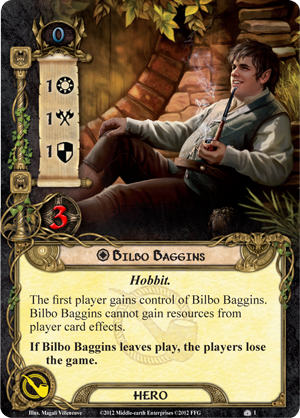
As a Saga Expansion, The Hobbit: Over Hill and Under Hill introduces three scenarios drawn directly from the classic story by J.R.R. Tolkien, as well as a host of new heroes and player cards. Players can use any of their other The Lord of the Rings cards while playing through the scenarios fromThe Hobbit, and most of the expansion's cards can be used in any other deck, for any scenario, but The Hobbit also introduces five unique cards specifically designed for the expansion’s scenarios. These include Bilbo Baggins (The Hobbit: Over Hill and Under Hill, 1), an event with the Baggins sphere of influence, and the new treasure cards. These cards are only intended for use in The Hobbit: Over Hill and Under Hill and a second Saga Expansion, slated to arrive in late 2012, that will relate the second and final half of Bilbo’s adventures.
For more information about how these expansion-specific cards make The Hobbit: Over Hill and Under Hill a unique and engaging experience within Middle-earth, we turn to the expansion’s lead developer, Caleb Grace.
Caleb Grace on Bilbo, the Baggins sphere, and elven blades:
While we were working on The Hobbit: Over Hill and Under Hill Saga Expansion, one of the design team's top goals was to bring J.R.R. Tolkien’s story to life with the same unique mix of charm and peril found in The Hobbit. In his classic novel, Tolkien draws his reader into his fantastic world by exploring it through the eyes of Bilbo Baggins. We felt that the play experience of our Saga Expansion should follow suit. While Bilbo Baggins (The Hunt for Gollum, 1) already entered The Lord of the Rings: The Card Game as a playable hero, we wanted Bilbo to be more central to the events of The Hobbit. It wasn’t enough for Bilbo to pass around his card draw; we wanted each player to be able to take turns controlling the story’s central character, so we decided to create a new Bilbo Baggins hero that would be playable only in The Hobbit.
Adding another hero to the starting mix created some resource complications. How do you balance the game for a player who generates a base of four resources? And if Bilbo is just another hero, granting another resource, how is he special? Ultimately, we decided the best way to make Bilbo special was to add a new sphere of influence to the game: the Baggins sphere. By giving the Hobbit his own sphere of influence and giving players opportunities to gain benefits from using his resources within each scenario, we hoped players would feel like they’re reliving Bilbo’s adventures right alongside him.
Just like in the book, the unlikely burglar can either help or hinder his companions. As a free fourth hero, he boosts his controller’s strength, but because the players will lose the game if he leaves play, Bilbo can force players to play more cautiously. Meanwhile, his Baggins sphere resources allowed us to recapture some of the ways Bilbo influenced the company’s adventures, and they really make him stand out. His resources can be used to help the heroes on their journey at different times throughout the scenarios in The Hobbit: Over Hill and Under Hill. Because these resources are so pivotal, we didn’t want players to use cards like Steward of Gondor (Core Set, 26) to gain more, or some of the most unique elements of the quests could be rendered insignificant. Thus, we added the line, “Bilbo Baggins cannot gain resources from player card effects.” This makes sure that deciding when and where to spend his Baggins sphere resources will remain an interesting part of the game.
Meanwhile, the design team had long been eager to explore the idea of treasures in The Lord of the Rings: The Card Game, and The Hobbit seemed like the perfect place to introduce this new card type. Part of the appeal of the game’s scenarios is that they string together to tell a larger story. Each individual scenario your heroes undertake is but a part of the overall narrative. Still, it can be difficult to build continuity between the different chapters of that story when you can change cards, even heroes, along the way. We wanted to present players with incentive to change their approach to deck-building and game-play, and treasure cards gave us an answer; in order to include these powerful artifacts in their deck, players must first discover them in a specific scenario. After that, so long as players use the same heroes who found them, they can use those treasures in subsequent, related scenarios. These treasure cards represent some of the most famous artifacts in Middle-earth, like the elven swords that Bilbo, Gandalf, and Thorin found in the troll’s cave. Accordingly, they have strong abilities in that make them well worth the effort to discover and play in later scenarios.
Thanks, Caleb!
The whole design team has put a tremendous amount of time, energy, and love into The Hobbit: Over Hill and Under Hill to bring it as close to Bilbo’s adventures as possible.

Sunday, April 15, 2012

When it’s time to move on from those old titles you love…


When it’s time to move on from those old titles you love…


Over the years I’ve amassed quite a number of board games that I’ve loved and played to death and that have then gone cupboard- or attic-wards and disappeared into obscurity collecting dust and forgotten memories like weird cardboard time capsules.

A few years ago I had to have a bit of a clean out to make room for our rapidly incoming child and that little purge saw a stack of the old 80s/90s Games Workshop titles hit eBay.  Goodbyes were said to a few notables:


Dark Future – a game I’d bought purely off the back of the Fighting Fantasy game book Freeway Fighter.  I loved the idea of breaking out some old matchbox cars and modding them to make ever more cars to race and blow up.  It was sort of a weird skirmish/race game that like most of those old GW games was massively over-complicated for what it actually delivered.  I also seem to remember that motorbikes were pretty shit because if you were in a car you could just ram them off the road.  Although we might have been playing that one wrong to be fair.  Still, those desert road pieces were pretty cool, as were the little machine gun turrets on the Interceptors.


Blood Bowl + Dungeon Bowl – we played the heck out of this.  I had tons of extra rules and players hacked from the pages of White Dwarf magazines, a hardback manual of Star Players, dungeon tiles with spiked balls and treasure chests and an ongoing league wherein we tried to continually murder each others’ players.  I think it might have ended up being too comical or light for me and my mates at the time though.  We ended up preferring to run around dungeons killing things and nicking their loot rather than tossing a ball at them.


Mighty Empires – I genuinely loved this one actually.  The ‘sweeping conflict’ it promised was all there, we even tried the Warhammer Fantasy Battle version and broke out into armies to resolve skirmishes.  That didn’t last long though – far too much hassle.  So we ended up playing it for what it was, and it was still great fun.  Again, I had a ton of extra bits and pieces for it, necromancer’s towers, sea tiles with pirates and such.  The game always seemed to resolve itself during the winter for us.  As our armies camped down and prepared for the coming weather and hardship we’d all plough our resources into saboteurs and assassins and agents.  I think assassins could literally kill 100s of points’ worth of troops if I recall correctly, so you’d send in a few ninjas and utterly decimate your opponent’s forces.  Come springtime they’d have virtually nothing left to fight back with and you’d win.  If it even lasted that long.  Too fiddly and bitty in the long run – and the pieces didn’t age well, especially compared to the sort of conquering games you can get these days.  FFG’s Runewars or WOTC’s Conquest of Nerath come to mind, though I’ve never played either title I’d like to try them some day.


And now I find myself in a similar position of having to find room once again, especially because of all the gaming acquisitions I’ve made in the meantime.  So this year/week/day it’s goodbye to the following:


Talisman 3rd edition The game is great and all but I have second edition with all the expansions (except Dragon – redonculously over-priced on eBay to the point where I wouldn’t even consider tracking it down) so 3rd edition, despite the cool board and all the skulls, skulls, SKULLS is just so much wasted cardboard for me.  If I ever consider sticking 2nd edition on eBay someone here come and slap me upside the head.  Yes, it’s random as all hell, but it’s still my first true love (in a board gaming way).  Well, Talisman and HeroQuest…


DungeonQuest 2nd edition with Heroes expansion – I suppose FFG has redundantified this old beast now with their fancified new edition with all its lovely new artwork.  Either way I still love the simple “flip a tile - you’re dead” gameplay.  Sadly this has been superseded by the enormously superior D&D Adventure System games, whose cooperative nature and overall production values just outshine DungeonQuest in every way.  As my son grows up and if he chooses to ever play games with me, I’d always choose to play a cooperative dungeoncrawl game instead of this hackfest.  Great memories, particularly of the ninja in the Heroes expansion who I always played and hoped would be good, but who proved to be as useless as every other bugger when it came down to it.  Ninja your way out of a Revolving Door that hits the dungeon wall why don’t you?!


The Sorcerer’s Cave – Thought I’d share the love with this one – I picked it up on eBay originally and played it quite a few times.  It’s great fun, but I redesigned it with updated components so now it’s time for this version to move on and find another home.  I genuinely hope someone gets a kick out of it like I did.  It wouldn’t last a second in today’s competitive market with its simplistic design but you can see how it helped father the genre, and its ultimate goal of providing a cool RPG style story is extremely admirable.  Exactly the same goal in fact that I’ve aspired to attain with Fantasy Quest.  To that end I owe a ton to games like this and Talisman that inspired me through the years.


Buffy the Vampire Slayer: The Game US editionPicked this up from the US in a desperate bid to get my Buffy-fan wife into board games – it didn’t work.  So now this HeroQuest style Buffy themed curio finds its way onto eBay where hopefully someone will learn to love its unique and unusual mechanics.  This was a very ballsy genre game to make from a really successful TV show and let’s face it, it pees all over the UK Buffy game we got lumped with over here in the UK!  Its theme alone though will ensure it never sees play with my actual mates so off it goes.


Star Wars: Star WarriorsThis is one of those great old board games from the 1980s - when they used to make really cool games!   I’m loathe to see it go as I spent a lot of time with this one as a kid.  I even redesigned the rules entirely removing everything Star Wars from the theme and turned it into a sort of intergalactic empire building game.  You had a huge mothership (whichever ship token suited you), which you used to travel through space and conquer planets (asteroids) and fortress installations (gun batteries) whilst trading and meeting with and destroying other players and NPC forces that were also travelling around the board.  You could choose from a bunch of different racial types that gave you various different benefits or meant you traded for different types of supply (the evil races looked for slaves and conquering, the goodies looked to make trade routes and kill the baddies) and the one with the most VPs won.  I still have the rules for all this nonsense somewhere, maybe one day I’ll look at re-implementing it entirely if there’s anything worth salvaging in there.  We ended up playing that version a lot more because you seemed to have a much grander experience in a few hours than merely jinking and rolling your X Wing about until you could zap your mate’s TIE fighter after a few hours!  Still this was a fun game, just never seemed as, I dunno, epic (?) as we’d hoped for compared to how complicated it actually was.


So here's my seller's page in case any of these stories brings a tear to your eye or a tingle in your wallet, you've got a week to cash in  - oh, and they're all up for 99p each!:


http://myworld.ebay.co.uk/ninjadorg/?_trksid=p4340.l2559


Everything must go!!


Sometimes, it's just time to move on, and you've got to make those really hard decisions.  Tune in next week after I bid on my own items to stop them going and then suffer horrific buyer's remorse...


Friday, April 13, 2012

‘GLOOM OF KILFORTH: A FANTASY QUEST GAME’ - RULES VERSION 2.0

Finally they're here!  Nearly missed my own deadline too...


Please check for errors, grammar, and any other uncertainties and ask away here if you have any questions.  I've incorporated feedback from everyone who got back to me about the beta testing and have tried to cover everything that came up in the Living FAQ thread on this very site.

So thanks for all your help in getting the game this far and here’s to moving on to the next stage, with a sneak preview of the new Saga layouts below.  Here is the doc version of the rules:


Once it's all confirmed and checked over I'll transfer it to the full colour pdf and get that uploaded too.


Embeditin seems to have messed with the Word layout somewhat but hopefully it's all still legible...


Thursday, April 12, 2012

'Uncharted' Board Game From Bandai

ICv2 - 'Uncharted' Board Game From Bandai:

'via Blog this'

ICv2 have some details on the forthcoming Uncharted board game.  Looks more like a card game to me and I have to say the board looks depressingly unimpressive.  Coming from a line of PS3 titles I've been utterly addicted to I was expecting or hoping for something more, something beautiful.  Judge for yourselves below:


Wednesday, April 11, 2012

Fantasy Quest at UK Games Expo 2012

Hello Readers!


Just a little note to let you know that Mmzomba (Sam) and myself (Tristan by the way, nice to meet you) are booked in for Saturday and Sunday at the UK Games Expo 2012 and I’ve applied for a demo table on the Saturday too. Not sure if they have any left at this stage but if not I’m sure we can find a table or something somewhere. Otherwise it’s just going to be beers and browsing! So if anyone is going to be about it would be great to see you and maybe catch a game of Fantasy Quest too.  :)


Watch this space for the rules version 2.0 which will hopefully be released this week, along with the newly upgraded Saga cards...


Preview of Descent: Journeys in the Dark Second Edition

Fantasy Flight Games [News] - Gather Your Party:

'via Blog this'


Last year, we announced Descent: Journeys in the Dark Second Edition, the updated version of our classic dungeon-delving board game. This all-new presentation of the beloved title maintains the core experience fans enjoy – an epic semi-cooperative adventure in which brave heroes venture into dangerous caves, ancient ruins, dark dungeons, and cursed forests to battle monsters, earn riches, and attempt to stop the evil overlord from carrying out his vile plot. With its accessible rules and updated components, however, Second Edition remains deep enough for long-time veterans while inviting newcomers to join the adventure.
Today, we’re pleased to present the first in a series of previews of this upcoming release. First, we’ll offer a broad overview of what you’ll receive with Second Edition, which will lay the groundwork for more in-depth previews in the coming weeks. Then, we’ll see a few words from designer Adam Sadler in which he discusses the elements of Second Edition that excite him most.
A new take on classic dungeon-delving
Descent: Journeys in the Dark Second Edition is a board game in which one player takes on the role of the treacherous overlord, and up to four other players take on the roles of courageous heroes. Featuring double-sided modular board pieces, countless hero and skill combinations, and an immersive story-driven campaign, Descent: Journeys in the Dark Second Edition transports heroes to a vibrant fantasy realm where they must stand together against an ancient evil.
This updated version of the classic board game of dungeon-delving adventure features a host of enhancements, including new heroes and monsters, accessible rules, a class-based hero system, campaign play, and much more. In addition to its nearly 50 detailed plastic figures, 48 map tiles, nine custom dice, and much more, Second Editionoffers a comprehensive Quest Guide with 37 original maps.
What exactly does that mean? Take a look at the game layout above. This introductory setup, entitled First Blood, is a single-map quest designed to get players acclimated with Second Edition. Typically completed in about 45 minutes,First Blood pits the heroes against a rampaging ettin (a man-eating, two-headed giant) and his goblin minions.
First Blood is unique among Second Edition’s quests in that it consists of a single “encounter”; other quests are made up of two linked encounters, which are meant to be played back-to-back in a gaming session of just under two hours in length. So getting back to the Quest Guide’s 37 maps, they consist of one introduction, 17 two-part encounters, and two possible interludes (longer maps that divide the narrative at its halfway point). All together, Second Edition offers enough content to ensure years of replayability!
Also noteworthy is that each quest (again, consisting of two encounters) can stand alone, or work as part of a larger campaign narrative. This close interrelation between maps is just one of the ways in which Second Edition shines; the outcome of the first encounter of a quest affects the setup of its second encounter. Did the heroes manage to save any villagers in part one? Is so, those same villagers may become useful allies in part two.
Extending this concept to campaign play is another matter. Second Edition features an engaging “plot tree” system that presents different encounters depending the heroes’ victories and defeats. Keep reading for Second Editiondesigner Adam Sadler’s insights on the game’s immersive and adaptive campaign system, plus the increased strategic options of the overlord!
A word from the overlord
As a longtime fan of Descent: Journeys in the Dark, I was thrilled to get the chance to design Second Edition. Overall, the biggest challenge the design team faced was updating certain elements of the game while still staying true to the vision of the original. Right out of the gate, I knew that campaign play had to be a major element. While we wanted to maintain players’ ability to fully enjoy the Descent experience in single, self-contained sessions, it was equally important to include options for long-term character development and wider narrative arcs.
This brings me to the first aspect of Second Edition that I find most engaging. To keep campaign play interesting and varied, players will not always experience the same quests, or experience them in the same order, when playing through The Shadow Rune (the included campaign) multiple times. In fact, there is a well developed narrative driving the campaign that can branch off in different directions. Depending on whether the heroes or the overlord win certain quests, the players can actually influence how the overarching plot plays out. This brings a sense of light roleplaying to Second Edition, while giving players a feeling of ownership over their heroes’ fates.

A pad of these campaign tracking sheets is included with 
Second Edition,
allowing players to record the winning team for each quest. In addition to
determining what the next quest will be, this record helps establish other, more
subtle narrative factors throughout the campaign.
Another element of Second Edition that I think players will appreciate is the enhanced role of the overlord. I wanted to ensure that the overlord player would have plenty of compelling choices to make during a game.
Like the hero players, the overlord can choose a class in which to specialize, and he can customize his overlord deck to better suit his play style. The different overlord classes allow the overlord player to focus his tactics in the areas he wants. This deck customization creates a very different play experience for both the overlord player and the hero players; the overlord can change his tactics as he goes and the heroes won’t know what to expect!
Working on Descent: Journeys in the Dark Second Edition has been a challenging and enjoyable experience for me. I look forward to fans of the first edition getting a chance to try the new game, as well as seeing newcomers begin their own adventures.
Thanks, Adam! With Second Edition’s momentous release on the horizon, we’ll be ramping up our web coverage. Check back often for more, and prepare to enter the dungeon this summer!