Hall or Nothing Productions Ltd: Star Wars: The Card Game
Showing posts with label Star Wars: The Card Game. Show all posts

Tuesday, November 13, 2012

NinjaDorg's Star Wars: The Card Game Review


I was definitely one of those looking forward to a cooperative Star Wars game, especially after how successfully Fantasy Flight handled The Lord of the Rings: The Card Game.  Early reports on the game play of the cooperative Star Wars card game were positive too and I was eager to see how it played out.  My group will play competitive games no hassle, but it’s great to have the option to play cooperative games with less gamer-y friends and family and maybe to have a solo option for when the family is tucked up in bed.  So when I found out it was no longer a coop game I was initially disappointed.  But the only previous Star Wars board games I played were Star Wars Monotony and Star Warriors (which I just recently e-Bayed), and the notion of playing a cool, up to date, and still supported game in the Star Wars universe was very appealing.

After reading the rules the game seemed fairly dense, but clean and concise, although it took me a while to process all the obligatory new terminology.  My initial worries:


1. Familiar Objectives – the objectives looked very much like the stories in the Call of Cthulhu LCG, and the rules overall lent a heavy sense of the Game of Thrones LCG.
2. Edge Battles – they seemed overly long and complex for what they are, i.e. giving one side the Edge in the forthcoming battle.  I also wasn’t excited about potentially playing an entire hand of cards to resolve the Edge before one single battle.
3. Focussing – I was dubious about how adding focus tokens to represent exhausting cards would work out when tapping/exhausting seems so much easier.
4. Theme – yes, I know Darth Vader is going to have kick ass stats compared to regular Trooper, but will the overall feel of the game give a sense of the Star Wars universe?


Sam and I geared up for a two player war and the decks were Light Side (LS): Jedi – myself - and Dark Side (DS): Dark Jedi – Sam - so we shuffled up and set to it.  The first couple of turns took an age as we tried to process all the new mechanics and asked a bunch of ‘what if?’ questions and rules look ups that wouldn’t necessarily affect our immediate game, but that we wanted straight in our heads.  Deciding to ‘trust our feelings’ we just played on and let the game emerge by itself through the card play, agreeing that we wouldn’t put too much truck in who won or lost because this was our first ‘test’ game.

Boy, did that feeling soon go!  As the Jedi I was up against it from the get go – the general feeling is that the good guys are up against it.  The ticking counter of the Death Star dial suggests that the Dark Side (DS) will inevitably win in - at most - 12 turns (potentially less if they play well) and that the Light Side has to play all out and pull no punches just to survive.  The Jedi desperately need to destroy 3 DS Objectives.  Sam quickly tapped out his resources and brought in some basic troops, then applied Dark Jedi units to commit to the Force and as I played down a couple of lesser Jedi I foolishly considered that I didn’t have the resources to do the same, so I let the Balance of the Force slip inexorably towards the Dark Side, meaning the Death Star dial advanced twice every turn.  I never managed to reclaim the Balance of the Force, which meant I would only have 6 turns to win...

I straight away concentrated my Jedi forces on attacking the Dark Side Objectives.


I love the Objectives!

These are really thematic story implementations of the power of each side of the Force, so you can strike at for example the Council of the Sith or Cruel Interrogations Objectives and you’ll need to inflict 5 damage to defeat one.  And as long as each of these are in play you get a cool bonus effect, e.g. card draw, or certain cards cost less to play, or the Cruel Interrogations Objective for example immediately captures one of the Light Side player’s cards (from hand) and must be destroyed for said captive to be released.

So you can prioritise the Objectives based on their difficulty and game effect, adding a deeper ongoing strategy level in how you approach your enemy.  Whilst the DS player can sit back and build his armies and ships it also behoves him to attack the LS objectives too, which helps advance the Death Star dial even faster and forces the LS player to consider defending his own play area instead of constantly going on the attack, thus delaying the game and leading ever close to that inevitable Dark Side victory.  Sam’s Dark Jedi didn’t hold back in this regard and as I focussed all my units on the offensive he plucked some low hanging fruit by sending in fighters in to destroy my home bases on Tatooine and other noteworthy Star Wars locations.

As my two Unopposed Twi’lek Loyalist Jedi attacked at the heart of the Empire in Coruscant Sam played some vicious response Events such as Intimidating Presence and Force Choke to cripple one Jedi with Focus tokens (so THIS is why you don’t exhaust/tap cards – you can be a lot more exhausted in this way) and damage the other.  But the damage had already been done and one of the DS objectives was nearly destroyed.  Quickly realising how deadly unopposed attacks could be Sam pulled his forces back from the offensive and even those who were committed to the Dark Side of the Force came to defend the Empire.

To step up the attack I brought in more resource generating cards and more powerful units such as Obi-Wan Kenobi and re-launched my attacks.  This time Sam was ready and sent his units to defend, thus instigating our first Edge Battle...


I love Edge Battles!

Getting the Edge is crucial in unlocking the much needed extra character icons you benefit from in the ensuing battle.  The fact that you draw back to 6 cards at the start of your turn means you can afford to throw in more of the cards that you feel you need to in order to win, but you also have to be prepared for up to three potential edge battles during each player's turn.  Poker-faced, we played our cards face down in stacks and I visibly winced as Sam kept adding cards to his stack against my own measly one card Edge Stack.  Eventually he also passed and we revealed our Edge Stacks to compare our total number of Force icons.  But my one card played was a Twist of Fate, a nasty little Fate card cancelling all of his mega Force cards and starting a brand new Edge Battle instead!  This time I played some big Force cards into the stack and won the Edge.  Obi Wan attacked and destroyed the first DS objective and a cheer went up throughout the galaxy.

But had it been in vain?  Emperor Palpatine cast down his Force Lightning event on an exhausted Ben Kenobi and annihilated him utterly.  And then the Empire struck back against my undefended objectives and destroyed one for themselves.  The Death Star dial advanced yet again and I wondered at leaving my bases so badly unprotected.

At which point Luke’s own Red Five X-Wing Fighter swooped in to save the day.  Delivering a huge payload of damage to my next DS Objective after another hard fought Edge Battle I managed to take down another DS Objective, but at cost.  The Emperor countered by showing up in person with his henchmen and attacking and destroying another of my own LS Objectives, advancing the Death Star dial twice this time, and in Spinal Tap fashion reaching all the way up to 11.  At the start of his next turn, Sam would win the game automatically.

It all came down to a certain Luke Skywalker and his fearless band of Freedom Fighters.  Before I could begin my final assault the Emperor played an event attack on one of my brave yet feeble units, the Believer in the Old Ways.  But Luke deflected the damage with his lightsaber and took out an evil Nightsister instead.  Then the assault began: as Emperor Palpatine confidently moved to intercept my encroaching forces I played an old and true Jedi Mind Trick and diverted him away.  The final imperial Objective was undefended!  As Skywalker and friends moved in the chances of victory were as slim as launching proton torpedoes into an exhaust vent to destroy an entire Death Star.  So, a dead cert then.  As the Council of the Sith exploded in a shower of sparks and flame the Jedi rejoiced in victory!

Interestingly we swapped roles for the next game and it came down to the absolute wire again, with Luke turning up for a last second attack on the third DS Objective.  I’d grown extremely cocky because due to a bad run of cards, Sam had been unable to play much of anything on the Jedi side.  Meanwhile I had lined up Vader, the Emperor, a Coruscant Defence Fleet and a bunch of Imperial Guards.

The Jedis attacked my Empire with the awesome Capital Ship Redemption and I was more focussed on being able to destroy the Redemption than in defending myself properly.  I sent everything at it and won the Edge just to watch the Redemption go down in flames.  Only to then have Luke sneak in the back and destroy the third and final Objective resulting in another close to the bone LS victory.

It was late but I was determined to see if I could steal a Dark Side win, so we played on again until well after midnight.  I also was very curious to see if the Heart of the Empire Dark Jedi Objective was as awesome as it appeared to be.  It generates 3 Resources per turn instead of the usual 1, and requires 10 damage to defeat instead it of the usual 5, but if you lose it you lose the game, so you have to defend it at all costs.

By now we’d both wised up to the Edge battling, and a rough idea of the overall tactics and strategic play, even down to the ’faking fear’ at big Edge stacks whilst knowing you’d played a cheeky Twist of Fate.  After a gruelling, protracted battle it came very close once more, with the Heart of the Empire almost in ruins and massive casualties on both teams, even to the point where we’d nearly played through our whole card decks from aggressive Edge Battling (you lose if you run out of cards).

This time Luke Skywalker had been destroyed by Force Lightning and Ben Kenobi and his allies were struggling to make the final push to their objectives.  As Vader fired up his very own personal Light Saber and dedicated himself to the Force, the Balance of the Force tipped towards the Dark Side and with a roar of inevitability the Death Star came online.  It’s opening salvo was the destruction of Tatooine, and the rest of the galaxy would follow...

The thematic implementation is simply brilliant.  Desperately sending a band of freedom fighters up against the Empire’s most elite units in the vain hope that you can twist fate to your advantage and somehow get the Edge against your enemy to bring balance to the Force?  Sign me the hell up.  The heroes and villains feel exactly as heroic and villainous as you expect them too, and there are other great surprises in the decks too, with brilliant references to and quotes from the movies.  It was after 1am and I still wanted another shot at the game afterwards.  I absolutely cannot wait to see how the Empire Vs Rebel decks play out too, and every permutation thereof, that’s before we even get to the Smugglers, Spies and Bounty Hunters.  There are even fricking Scout Walkers in there for goodness’ sake.  It’s been nearly thirty years since the foot ‘fell off’ my own Scout Walker toy and this is potentially the happiest I’ve felt in the Star Wars universe since before then.  So glad they chose the original setting for this game too, although I honestly would not be opposed to a Trade Vs Republic version too.


Other notes:

1. C3P0 sucks – exactly like he does in the movies!  His effect is largely a joke, but one of our stand out moments was when Sam – bravely going against our usual tactic of sacrificing him for edge battles or event cancellation – committed Threepio to the Force, making him all that stood in the way of Darth Vader and galactic domination!  I destroyed him with a Force attack in the next turn, but it was a valiant stance from the erstwhile super-camp, useless golden butler.
2. R2D2 rocks - exactly like he does in the movies!  Not the flying Superman version from the prequels, the nippy, resourceful little tub of nuts and bolts from the originals.  1 resource per turn might not be much but it adds up and makes him a genuinely great little card.
3. In a desperate Edge Battle a Jedi Believer in the Old Ways ran up to the Emperor and wounded him with a Light Saber before being mowed down by overwhelming forces.  It had a small effect on the long term game but was a great cinematic moment which had us both invested quite heavily in the fate of one brave little unit.
4. The artwork is once again utterly fantastic, and at least on a par with The Lord of the Rings LCG.  This is the best route FFG could have gone imho, with art versions of these awesome iconic characters and moments along with great new interesting characters, ships and events from the 'Expanded Universe' too.


How does it compare to LOTR: LCG?

Well, these two games could easily sit comfortably next to each other as they both fulfil very different purposes.  SW is currently a 2 player versus game, but there is easily scope for multiplayer battles, and even potentially a cooperative translation too, though that may require much more of an overhaul.

Currently I could not be happier with this game, and cannot wait for the next opportunity to play it!

Tuesday, November 06, 2012

Designer Eric Lang on STAR WARS: The Card Game


Original link:

Recently, we started our series of previews for Star Wars: The Card Game™ with a look at the game’s unique model of deck-building. Today, as we wait for the opportunity to control the Star Wars universe’s most legendary heroes, villains, and starships, designer Eric Lang kicks off our series of previews with a look at how the game was built to capture the magic of the movies!
Eric Lang on “The Cinematic Experience”
The first “real” movie I saw in the theater as a kid was Return of the Jedi. It blew my mind and forever changed my impressionable young view of just what a movie could offer. I remember the first time I saw the assault on the Death Star and Luke’s epic showdown with you-know-who. The line, “Go on, strike me down!” gave me my first serious movie chills. Call it cliché, but those scenes changed my life. I came out of that theater reborn as a bona fide geek!
Watching the classic Star Wars movies again as an adult brings me back to that place of youthful awe. They transport me back to that transformative moment, and I’m again overwhelmed by their relentlessly awesome scope. Everything is larger than life, everything is epic. Most importantly, they explain only enough to excite our imagination, where even in the moment, we are freed to dream about the universe beyond the scene. It’s magic. Such moments make us feel.
I’ve known for years what I wanted to do with a Star Wars card game. I wanted the game, like the movies, to transport me to that primal place, to rekindle the spirit of those scenes, and to give me the tools to dream beyond the moment.
I wanted to make a game that was quick and action-packed, but where every tiny interaction held the promise of greater scope, even if you didn’t see it at the time. I wanted my Star Wars to be a game that captured you in the moment and made you think. More importantly, it needed to make you feel.
Cutting to the Action
Living Card Games® (LCGs), in play, do one very interesting thing very well: they simplify complex ideas into visceral, flavorful interactions. In Star Wars: The Card Game, I call these interactions “movie moments,” and I wanted the game to focus entirely on delivering them turn after turn.
I dubbed this vision “cinematic design.” Every facet of the game stems from this idea – from the new style of deck-building to the quickness and open-endedness of battle, card interactions aimed at capturing spirit over direct simulation, and the game’s dramatic, bluff-tastic edge battles.
My first goal was to whiteboard a series of “movie moments” I wanted to see find shape in the game. Having played (and designed) several games based on licenses I love, I saw this as an obvious first step. Since this was a card game, I knew early on that I wanted to get to those moments right away and not worry about anything else. In a way, this game could play out like a hundred different trailers for your own Star Wars experiences.
The scope of the LCG brings these moments into stark relief: on turn one, you’ve already dived in and played through at least one scene. And the pressure is on as the game progresses – if the light side doesn’t mount an offensive, the dark side automatically wins. But the game favors the aggressor overall, so the dark side player can’t just defend and win. He has to take advantage of every opportunity, figure out what is important to the light side player’s strategy for that game, and Force choke him out of existence.
Cinematic gameplay focuses on the big picture, the excitement and the stakes. Whatever gets in the way of this focus is trimmed or cut, leaving us a lean, mean, action-packed game!
Building the Set
What really excited me about designing Star Wars for the LCG format was that I got to try a wholly new approach that could only shine with this awesome platform FFG had developed. One of our big innovations in this game is its approach to deck-building itself. We kept the quality of decisions, heightened the stakes between the choices, and trimmed the rest.
As you saw in Nate French’s previewStar Wars: The Card Game allows you to customize your own decks between games, but it takes a different approach. Choose at least ten different objectives, each linked to a set of five more specific cards, and your deck is built! Simple to explain, simple to dive in and experiment. But just as with many classic games, once you dive into the decision-making process of set-building, the depth quickly becomes apparent.
Set-building has several advantages, but two of them outshine the rest. The first advantage, which I’ve dubbed “Trust Your Feelings,” is that it simplifies deck-building both in the critical early stages when you start playing, and at any point in the future when you return to the game after a break.
Equally exciting is that Star Wars: The Card Game offers a completely new way for experienced players – Jedi Masters, if you will – to look at building their decks. The overall number of decisions they face is fewer, but the stakes of those decisions are very high. Nate did a great job of summarizing this earlier. You have to adjust your thinking and see how the Force binds all things. The value of a card lies not only within its own stats and abilities, but in those of the surrounding cards in the same objective set.
In design and development, we put a lot of thought into how the objective sets are built. Objective sets are organic entities, and they’re designed as a whole. This means they don’t just open new avenues for players; they create new possibilities for game design. In fact, one of my design mandates for future sets is “design sets; the cards will follow."
Edging Closer to Victory
Another innovation built into the game is the edge battle. Conflict is at the heart of Star Wars: The Card Game, and since players will be in engaging in many different conflicts over the course of play, I wanted to make sure there would be a high amount of variance. Additionally, I wanted to make sure the game offered a hefty dose of uncertainty in conflict, as this captures the spirit of the classic Star Wars movies.
Edge battles are blind bids for initiative that capture those moments when forces maneuver into position or circle about each other in tense lightsaber duels. Each card in the game has a number of Force icons, and the player who bids the most Force icons wins the edge, the initiative, and the chance to strike first in the ongoing combat. But once the initiative has been decided, all cards used to bid are discarded, and this increases the tension of each edge battle.
Winning the edge is a crucial component to winning the game because it not only gives you that important first strike in an opposed conflict, it unlocks the true potential of many cards in the game. But you don’t have to win the edge all the time. You can’t win it all the time. You have to manage which cards you are going to keep back to try and win the crucial edge battles.
Additionally, the Force icons that would help win you edge battles are also useful on units in play, as they can contribute toward tipping the balance of the Force in your favor. This is another important element of the game to manage, and you’ll have to decide from deck to deck, game to game, and round to round, which victories are more important to you…because you certainly can’t win them all.
The decisions you face in edge battles mean your choices each turn are a bit less about how to squeeze the most out of your resources and more about how you manage the use of your cards overall. More importantly, they may lead you to manage a few cards over the course of multiple turns, sculpting your hand for a perfect alpha strike when you need it. Of course, doing that denies you the ability to play those cards…oh, the dilemma!
You’ll get more thoughts about design in future articles. In the meantime, I hope Star Wars: The Card Game unlocks as many movie moments and moments of joy for you as it does for me!
    –Eric Lang, Designer Star Wars: The Card Game
Thanks, Eric!

Thursday, September 06, 2012

Announcing the Upcoming Release of STAR WARS (TM): The Card Game


From FFG here:


The Imperial fleet sifts through the galaxy for signs of the Rebel Alliance’s hidden base, hoping to obliterate it with one powerful blast from their newly constructed Death Star. As the Empire’s imposing Star Destroyers draw near, the Rebellion’s greatest heroes realize there is no time to spare, so they mobilize for a desperate attack…
Star Wars: The Card Game is coming! Scheduled to release in the fourth quarter of 2012, Star Wars: The Card Game is a head-to-head Living Card Game® of tactical combat and strategic planning that allows two players to wage cinematic battles between the most memorable characters and starships from both the light and dark sides of the Force.
In February, we explained why we chose to take our initial prototype back to the drawing board. Now we are proud to announce that the redesign by Eric M. Lang is complete, and we intend to make Star Wars: The Card Game available to retailers everywhere later this year!
Luminous Beings
For decades, the Star Wars universe has entertained millions of fans with its daring heroes and imposing villains. Now, Star Wars: The Card Game grants players command of some of the galaxy’s most memorable characters. Wage epic duels between Luke Skywalker and Darth Vader, send Han Solo and Rebel troopers to engage Imperial forces on Endor’s forest moon, or launch a fleet of Star Destroyers from the Kuat ship yards. Of course, stormtroopers, smugglers, starfighters, and bounty hunters all make appearances, along with other Jedi and Sith.
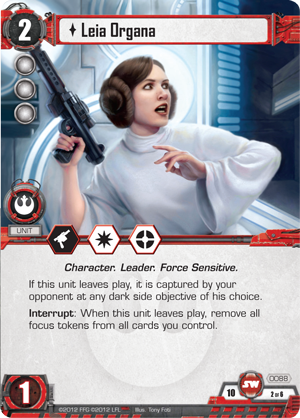
Star Wars: The Card Game allows you to recreate the drama and excitement of many of the movies’ greatest scenes, and it allows you to invent your own moments of magic, as well. Obi-Wan can sneak through the Death Star while Luke, Leia, and Han fight off stormtroopers, or you can unleash Darth Vader on an unsuspecting Rebel base. Lure the Imperial navy into the trap planned by Admiral Ackbar. Or capture Admiral Ackbar with the infamous bounty hunter, Boba Fett. When you command the game’s famous characters and starfighters, the possibilities for cinematic drama are as limitless as your imagination.
A Great Disturbance in the Force
In Star Wars: The Card Game, light side and dark side players duel for the fate of the galaxy. While the light side player races to make tactical strikes against dark side objectives, the dark side player works to reinforce his position of command.
Throughout the game, the dark side works to snuff out the last remnants of its opposition and secure total control of the galaxy. This is represented by advancing the game’s Death Star dial. The dark side advances the dial at the beginning of each of its turns and can accelerate its advancement by launching successful attacks against the light side. If the dial advances to “12,” the dark side wins. Given enough time, the dark side player will discover the last remnants of the light side’s resistance, and wipe them out of the galaxy with one final, commanding gesture.
Thus, just like in the movies, time is always running out for the light side, who must find the means to strike quickly and for maximum damage. The light side player wins by destroying three dark side objectives, cards that represent its missions and strategies, but doing so requires mustering sufficient firepower to get past Imperial defenses.
Each battle in Star Wars: The Card Game allows attackers and defenders to coordinate units, including characters, creatures, starfighters, and vehicles like Imperial walkers, to disrupt their opponent’s strategies by launching surgical strikes or beginning massive battles. First, the attacker targets an enemy objective and commits units to the assault. Then, the defending player assigns and commits units to the defense. As the two strike teams collide, players vie for the upper hand in the game’s dramatic new “edge battle.”
In an edge battle, players vie for initiative by secretly bidding cards from their hand facedown, one at a time, beginning with the active player. Once both players have passed or run out of cards to bid, they compare the number of Force icons on the cards they’ve bid, the cards they bid are discarded, and the winner gains the edge, earning the right to strike first.
The edge battles of Star Wars: The Card Game are high-stakes gambles that ensure that no cards in a player’s hand are ever without value. However, they can also be filled with dramatic twists and turns. Fate cards can trigger abilities when bid during edge battles that can wound units or damage objectives, and skillful players can even draw out their opponents’ most valuable cards in cunning feints. Each edge battle allows players to decide their own destinies, and each gives players a meaningful reason to consider whether to play a card or save it for a future edge battle.

One of the light side’s most powerful and versatile warriors, Luke Skywalker’s strength with the Force is represented by his three Force icons.
With its layered resourcing, tactical combat, and exciting edge battles, Star Wars: The Card Game immerses players in fast-paced confrontations set during the timeline of the original trilogy. You can read more about the game’s mechanics on its description page.
The Future You See
Star Wars: The Card Game pursues an innovative new style of set-focused deck-building. Each player chooses an affiliation card and a group of ten or more objective sets, each of which includes six cards: one objective and five corresponding cards that go into a player’s command deck. The compositions of players’ command decks are automatically determined by the objectives they choose. Just separate your objectives from your command deck, shuffle both, and you’re ready to play! This brand new approach makes deck-building more accessible to new players, as they have only to select ten objective sets and combine them rather than assemble an entire deck, individual card by individual card.
This model also presents a compelling new deck-building challenge for veteran card players. Traditionally, veteran players approach customizable card games by evaluating the worth of every individual card in a deck. Star Wars: The Card Game, however, explores exciting new design territory; players are faced with the task of evaluating groups of cards and building a deck by selecting among those groups. This new approach allows for intense strategic customization, while still maintaining core thematic elements from the Star Wars saga.
Faster deck-building and truly awesome legends – that’s the idea behind the new way to construct your decks in Star Wars: The Card Game!
Ally with the Force
The Force is a powerful ally, and both light side and dark side players will seek to draw from its strength as they engage in the battles of Star Wars: The Card Game, coming in the fourth quarter of 2012!

Monday, February 06, 2012

Fantasy Flight Games [News] - An Update on Star Wars: The Card Game

Fantasy Flight Games [News] - An Update on Star Wars: The Card Game:

'via Blog this'


In August, we announced the upcoming release of Star Wars: The Card Game, a Living Card Game® based on the original Star Wars trilogy. Today, we would like to share an update on its development.
Fantasy Flight Games’ current catalog of LCGs® offers a variety of exceptional and unique gameplay experiences, with the LCG® format among our most successful publishing categories. With this in mind, we want to make sure that Star Wars: The Card Game features a truly groundbreaking LCG® play experience.
The game we showed off at Gen Con 2011 would have been a strong addition to our LCG® catalog. However, as we were making the final touches to the product, we came to the realization that while it was a good game, it simply was not the greatest, most engaging game experience that FFG could deliver. So, we made a difficult decision and went back to the drawing board on the Star Wars: The Card Game design.
How will this affect the release date?
We are currently expecting to publish Star Wars: The Card Game worldwide just before the 2012 holidays. That said, it can be difficult to predict when the creative process will end, so this date should be taken as an estimate.
While we are disappointed that our original estimated release date will not be met, we are sure that our players would agree that our decision to delay Star Wars: The Card Game was the best one. We are absolutely confident that with the extra time this affords us, Star Wars: The Card Game will become one of FFG’s greatest products ever.

Tuesday, August 02, 2011

FFG Star Wars: The Card Game

Star Wars: The Card Game 


What now, FFG - am I to re-mortgage my house??


Daring Rebel spies have uncovered a weak point in the Galactic Empire's defenses. Tensions run high as the Rebels assemble a strike team with one chance to set back the Empire's quest for total galactic domination, but with zero margin for error! Coordinating hit-and-run attacks to distract the Imperials, the Rebel Alliance relies upon a handful of heroes to undertake a vital mission…
Star Wars: The Card Game is a cooperative LCG that puts 1-4 players* in command of the Rebel strike force and mission team. Players will launch fleets of starships and direct some of the most famous heroes in the Star Wars galaxy as they confront the might of the Empire. By working together, players can fend off Imperial assaults and complete their mission, winning the game! In Star Wars: The Card Game, players take the roles of such notable heroes as Luke Skywalker, Han Solo, and Princess Leia as an Imperial deck opposes their mission attempts with a devious artificial intelligence. With a wealth of characters, starships, missions, and enemies, Star Wars: The Card Game immerses players in galactic conflict.


Looks like they're learning from their mistakes with the LOTR: LCG too...

" Players can create two standard tournament decks with the contents of a single core set"


And here are a couple of Ship cards taken from a still of the FFG promo video: