Hall or Nothing Productions Ltd: The Redhorn Gate
Showing posts with label The Redhorn Gate. Show all posts

Tuesday, February 21, 2012

Heroes in The Redhorn Gate, Part Three


From the FFG article here:


“If Gandalf would go before us with a bright flame, he might melt a path for you,” said Legolas. The storm had troubled him little, and he alone of the Company remained still light of heart.
   “If Elves could fly over mountains, they might fetch the Sun to save us,” answered Gandalf. “But I must have something to work on. I cannot burn snow.”
   “Well,” said Boromir, “when heads are at a loss bodies must serve, as we say in my country. The strongest of us must seek a way.”
   –J.R.R. Tolkien, The Fellowship of the Ring
Two weeks ago, we explored how different combinations of heroes might each tackle the unique challenges of The Lord of the Rings: The Card Game. Decks take on different personalities and the game plays differently depending on your choice of heroes in your starting fellowship.
We believe this variety is a good thing. Players have different personalities, and they should be able to build and play decks that suit them. In solo games, a player’s deck establishes the tenor of the entire game. In multiplayer games, however, a player’s deck influences part of the game, but not the entirety of it. It’s impossible for a player to change the shape of the entire game with just one deck among two, three, or four, but players may certainly still play decks that suit their styles. In fact, multiplayer offers more room for specialized roles than solo play.
Today, we look at some of the current multiplayer archetypes and explore some of the cards that make help these decks quest successfully.
What’s your style?
As the player card and hero pools for The Lord of the Rings: The Card Game expand, players gain more options for deck customization, allowing for greater focus on a theme or role than the pre-constructed decks from the Core Setoffer. Many of these reconfigured decks benefit from the combination of heroes and player cards from two or more spheres of influence, combining complementary cards from each sphere to reinforce the deck’s overall purpose.
Below, we identify a few multi-sphere deck archetypes and look at how the heroes play into each of them:
TANK
Heroes: Gimli (Core Set, 4), Boromir (The Dead Marshes, 95), Frodo (Conflict at the Carrock, 25)
The tank’s role is to engage as many enemies as possible, and destroy them. Frodo may seem out of place, but he acts as the “armor” that allows the player to engage more than he can safely block. Absorbing enemies is just as important a part of the tank’s duties as is destroying them.
As long as you don’t hit fifty threat, you generally want a higher threat than your teammates so that you’ll draw enemies out of the staging area before they’re forced to engage your friends. Boromir and Frodo can both raise your threat. Just be careful that you don’t put yourself at risk too early. The Galadhrim’s Greeting (Core Set, 46) is an expensive event for the deck, but it can help you stay in the game longer to support your friends.
Also, allies with Sentinel can help you better defend your teammates. The Gondorian Spearman (Core Set, 29) and Winged Guardian (The Hunt for Gollum, 4) can both block attacks directed at your teammates, and a Feint (Core Set, 34) can come in handy, too. Meanwhile, as you focus on absorbing hits so that your teammates won’t, you can expect to suffer some casualties, making the Horn of Gondor (Core Set, 42) a perfect fit.
HEALER
Denethor (Core Set, 10), Eleanor (Core Set, 8), Glorfindel (Core Set, 11)
The healer’s role is to keep the party alive, both by healing damage and by mitigating the dangers of the encounter deck. While other players focus on questing, attacking, and defending, the healer plays a quieter and subtler role away from the front lines and all the game’s primary action.
Denethor’s ability to scout the top card of the encounter deck is more useful in games with fewer players because he grants you information about a greater percentage of the encounter cards you’re due to face. On the other hand, Eleanor’s ability provides greater impact in games with more players, where you’ll face more cards and it’s more likely a single treachery card may steer your heroes off their course. Critical to your use of the deck is knowing when to use these heroes’ abilities, rather than keep them ready to support your teammates by defending against enemies.
Still, you can supplement these abilities with cards like A Test of Will (Core Set, 50) and Hasty Stroke (Core Set, 48) to lessen the impact of surprises from treachery and shadow effects. And when your scouting fails, you can still help your teammates recover quickly from their bruises with Glorfindel and cards like Lore of Imladris (Core Set, 63), Daughter of the Nimrodel (Core Set, 58), and Beorn’s Hospitality (Core Set, 68).
Apart from Glorfindel, your heroes aren’t much good in a fight, but they are clever. Even though you want to direct your focus elsewhere, if you can prompt some Infighting (A Journey to Rhosgobel, 58) among your foes, you may be able to help your party finish off wounded enemies.
ADVENTURER
Aragorn (Core Set, 1), Éowyn (Core Set, 7), Imrahil (A Journey to Rhosgobel, 50)
The adventurer’s role is to focus as much on questing as possible, and a starting fellowship of Aragorn, Éowyn, and Imrahil can quest with the best of them. Players have long debated whether or not Éowyn is critical to success in the game. She’s not “critical,” but it’s hard to argue that her four Willpower isn’t helpful. In a four-player game, she can quest for as much as eight Willpower if each player sacrifices a card to fuel her ability.
Aragorn and Imrahil fit the deck because they both share two Willpower and the ability to ready themselves after questing. Aragorn readies if he pays a resource from his pool, making him an excellent candidate to serve as the Steward of Gondor (Core Set, 26), and Imrahil readies whenever a character leaves play, meaning that he can react swiftly if your Snowbourn Scout (Core Set, 16) or Westfold Horse-Breaker (Core Set, 6) is struck down by an enemy or rides off to ready another hero.
Plus, Aragorn is Middle-earth’s greatest ranger and the rightful heir to Elendil’s throne. Accordingly, he gets a little extra love and benefit from some cards like Celebrían’s Stone (Core Set, 27), which not only gives him two extra Willpower but also adds a Spirit icon. This means the fellowship can play two-cost allies like Westfold Horse-Breaker and Escort from Edoras (A Journey to Rhosgobel, 55) each turn, rather than needing to save for them. With their extra Willpower, the quester can race forward to put progress toward your quest each turn.

Thursday, February 16, 2012

Heroes in The Redhorn Gate, Part Two


From the FFG article here:


“I think no good of our course from beginning to end, as you know well, Gandalf,” answered Aragorn. “And perils known and unknown will grow as we go on. But we must go on; and it is no good our delaying the passage of the mountains. Further south there are no passes, till one comes to the Gap of Rohan. I do not trust that way since your news of Saruman. Who knows which side now the marshals of the Horse-lords serve?”
    “Who knows indeed!” said Gandalf. “But there is another way, and not by the pass of Caradhras: the dark and secret way.”


    –J.R.R. Tolkien, The Fellowship of the Ring
The heroes of Middle-earth undertake great and perilous quests in The Lord of the Rings: The Card Game, and their threats increase the more fully they come to the Dark Lord’s attention. As in Tolkien’s epic fantasy, the heroes find themselves in the role of the underdogs, a small band setting forth into dangerous wilds and treacherous mines, filled with Orcs, Trolls, and other monstrous enemies.
Among the first choices players must make are which heroes to include in their fellowships. Last week, Nate French explained some of the reasons the rules allow each player to select up to three heroes, and as a rule, it has historically been foolish to choose any fewer. However, this week we explore the development of Secrecy and the impact it may have upon your starting fellowship.
Smart and secret
When we announced The Redhorn Gate back in October, we hinted at the Secrecy mechanic the Dwarrowdelf cycle develops. In January’s article,Boromir’s Guide to Deck Building, Part Two, we defined Secrecy in its simplest terms and we discussed how it can give players a means to accelerate their resources. Players who can keep their threat at 20 or below gain greater card effects at discounted prices.
Still, Secrecy does something more than just accelerate resources. It opens up an entirely different path for deck construction. Because the safest way to ensure you can trigger the discounts of your Secrecy cards is to start with 20 or less threat, Secrecy encourages the design of fellowships with only two heroes (or even just one!).
Today, Lukas Litzsinger, the lead developer of the Dwarrowdelf cycle, discusses how the Secrecy mechanic took shape:
The evolution of Secrecy
While the Secrecy cards introduced in the Dwarrowdelf cycle can be used in any deck, they are easily most useful when you keep your threat at 20 or below. Players can use cards such as The Galadhrim’s Greeting (Core Set, 46) orGandalf (Core Set, 73) to lower their threat, but in order to take advantage of Secrecy from the very beginning of the game, you need a low starting threat, which may lead players to experiment with decks that play two heroes, or even just one.
However, Secrecy didn’t start in its current format. In fact, the mechanic went through a lot of revisions. Because the game already provides lots of incentives for players to lower their threat, anything that rewarded players for lowering their threat as much as possible had to be carefully implemented. Originally, we developed Secrecy cards that could only be played by players who ran just one hero. That was too restrictive, so we tried with two. Fine-tuning the cards became a major concern. If the Secrecy cards were too good, then players who started with three heroes would sacrifice their heroes just to play them, or they might be even more devious and play a bunch of Secrecy cards before reviving their hero with a Fortune or Fate (Core Set, 54). If the Secrecy cards weren’t extremely powerful, then no one would bother playing without a third hero just to use them. Ultimately, we deemed that restricting the mechanic based on the number of starting heroes (or even the number of characters in play) was too problematic.
Basing their play on a threat restriction felt more thematic. Threat already represents how visible your party is to enemies, so making Secrecy effects playable only by players with extremely low threat worked thematically. Since your heroes also set your starting threat level, running heroes with very low threat, or running fewer than three heroes makes it easier to play Secrecy cards without having to draw a lot of threat reduction. It also makes it easier to keep your threat low while the encounter deck tries to raise it.
The last change the Secrecy mechanic saw was the introduction of the variable cost reduction. At first, Secrecy functioned like an on/off switch, but players were too heavily penalized when their threat skyrocketed, making them completely unable to play a bunch of cards in their decks. So the Secrecy discount allows for a middle-ground, requiring a set threat level, but then giving various discounts to the cards. You can still play Secrecy cards without Secrecy, and building a deck with Secrecy cards that suffers an unforeseen spike in its threat level does not leave you with a bunch of unplayable cards in your hand. 
Secrecy will open up new strategies for players, and make them reconsider the default rule of three heroes to a deck.

Tuesday, February 07, 2012

Heroes in The Redhorn Gate, Part One - A spotlight on the heroes of The Lord of The Rings: The Card Game


From the original FFG article here:


Aragorn was the tallest of the Company, but Boromir, little less in height, was broader and heavier in build. He led the way, and Aragorn followed him. Slowly they moved off, and were soon toiling heavily. In places the snow was breast-high, and often Boromir seemed to be swimming or burrowing with his great arms rather than walking.
    Legolas watched them for a while with a smile upon his lips, and then he turned to the others. “The strongest must seek a way, say you? But I say: let a ploughman plough, but choose an otter for swimming, and for running over grass and leaf, or over snow – an Elf.”
   –The Fellowship of the Ring

With the completion of the Shadows of Mirkwood cycle and the release of Khazad-dûm, players now have far more heroes from which to choose as they build their fellowships, but how do you decide which to include? Are there any hard and fast rules about the best ways to combine heroes from different spheres? Have you ever wondered why The Lord of the Rings: The Card Game limits players to three heroes in the first place?

Let’s start by addressing the last of these questions first. While it’s true that players can choose to run fewer than three heroes, it’s generally not advised.

The rule of three

A two-hero fellowship (or even a solitary hero) may be able to make progress toward the quest for a period of time, while slipping beneath the notice of any enemies in the staging area, but eventually the mounting threats of locations and enemies are likely to catch up to a small party. The Lord of the Rings: The Card Game is intentionally balanced for three heroes.

The game’s designer, Nate French, explains:

Three is a really strong number for game design. It presents possibilities for different approaches to games that can appeal to different types of players. When you play a game, having to focus on three options can lead you to a balanced approach that works like a tripod leaning equally upon all three sides (a tri-sphere deck, with one hero from each of three different spheres), or you may take a split focus between a major sphere with support from a minor sphere (a deck with two Spirit heroes, and one Tactics hero, for instance). Still another option exists, and you can focus all your efforts on a single point of interest (a focused, monosphere deck).

Having only two options for heroes would be too limiting in possibilities; it creates situations that are all an either/or or a perfect mix. Four options, on the other hand, would start to enter the territory of allowing players to do “everything” right out of the gate, which would lessen the meaning and impact of selecting heroes in the first place.

Another nice aspect of having three heroes in The Lord of the Rings: The Card Game is that you have three major points of focus each turn: questing, defending, and attacking. With three heroes, your hero base can cover the three main points of the game. With four options, you would start getting to the point where you’re trying to spin too many plates at once. Card games are filled with constantly shifting rules as cards enter and leave play, and adding another multiplier can just prove overwhelming.
Split or focused spheres?

Nate offers both a nice definition of the challenges The Lord of the Rings: The Card Game offers fellowships and a similarly succinct definition of the various approaches players may take to building their fellowships. Each turn players need to divide their fellowship’s attentions between questing, defending, and attacking, and as they consider how best to meet those demands, players can choose to combine two or three spheres of influence, or rely upon the strengths of a single sphere.

Of course, your concerns for deck construction will be slightly different if you’re building for solitary play than if you’re building for multiplayer games. In multiplayer games, players can split the game’s three main tasks (questing, defending, and attacking) between the two decks, so that one player may be responsible for questing while the other may do the dirty work of defending and attacking. In solitary play, however, one fellowship must balance all three tasks.

Many players have long noted they’ve met with greater success when running at least two spheres, whether split between multiple players or combining heroes from different spheres in a solitary deck. This is because the spheres each excel at different aspects of the game (and different tasks). While there are no hard and fast rules about combining the spheres of influence, strong decks must have plans built into them to commit Willpower to the quest, defend and destroy enemies, draw cards, generate resources, and survive the nastiest Treachery cards the encounter deck can throw at them.

Typically, Spirit cards provide high Willpower and efficient means of canceling Treachery effects, Lore cards provide excellent card draw, Leadership provides resource acceleration, and Tactics provides you the means of surviving and quickly defeating even the nastiest enemies. If you draw upon the strongest and most appropriate cards for your deck’s theme from two or three of these spheres, you can gain the traditional benefits of both (or all three) spheres, and you may be able to focus your deck even more keenly than if you hewed to just one sphere.
Ploughmen to plough, otters to swim

While a deck’s “personality” may be most clearly expressed in a multiplayer game, even single-player decks can express dramatically different approaches to the game, starting with their selection of heroes.

QUESTER: Dúnhere (Core Set, 9), Éowyn (Core Set, 7), Theodred (Core Set, 2)
Starting threat: 24
A quester focuses on committing as much Willpower as possible to the quest, while facing as little resistance as possible. Éowyn and Théodred quest each turn, while Dúnhere skirmishes enemies in the staging area. Cards that reduce threat, such as The Galadhrim’s Greeting (Core Set, 46) and Gandalf (Core Set, 73), are key to the success of this deck as they allow Dúnhere to attack without ever first having to face an attack.

FIGHTER: Éowyn, Gimli (Core Set, 4), Legolas (Core Set, 5)
Starting threat: 29
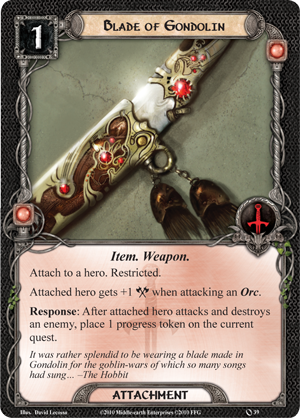
Unlike the quester, the fighter doesn’t shy away from getting down and dirty in combat. While Éowyn focuses on the quest, Gimli can take some hits and gets stronger for them. Legolas rewards you for fighting by adding progress tokens each time he helps defeat an enemy. An Unexpected Courage (Core Set, 57) on Gimli makes him a formidable combatant, and a couple copies of Blade of Gondolin (Core Set, 39) make felling foes even more rewarding.

SAGE: Beravor (Core Set, 12), Bifur (Khazad-dûm, 2), Bilbo (The Hunt for Gollum, 1)
Starting threat: 26
Knowledge is power, and knowledge in The Lord of the Rings: The Card Game is best represented by the cards and options in your hand. This focused trio of Lore heroes provides tremendous card draw, and you can add to it with Gléowine (Core Set, 62). The Lore sphere features a great number of cards to reduce the threat in the staging area and can convert card draw into Willpower via Protector of Lorien (Core Set, 70), but you’ll probably want to include some Songs to splash cards from other spheres.

PROTECTOR: Boromir (The Dead Marshes, 95), Eleanor (Core Set, 8), Frodo (Conflict at the Carrock, 25)
Starting threat: 25
This fellowship plays its low starting threat against the optional threat increases it can trigger from Boromir and Frodo to gain extra actions. As with the quester, the protector benefits tremendously from cards that reduce threat, allowing Boromir to quest, defend, and attack every turn. Cards you play to boost Boromir, such as Blade of Gondolin and The Favor of the Lady (Core Set, 55), provide tremendous rewards as he can use them all every turn.

JACK OF ALL TRADES: Aragorn (Core Set, 1), Beravor, Frodo
Starting threat: 29
Starting with three spheres, this fellowship can do a little bit of everything. Aragorn allows you to play Steward of Gondor (Core Set, 26) to accelerate your resources, while Beravor accelerates your card draw. You’ll have a lot of options in your hand every turn, and Aragorn and Frodo provide you with action advantage. Aragorn can pay resources to ready himself after committing to the quest, and Frodo can serve as a “defender” even while exhausted, absorbing damage as threat in times of need.
Looking ahead
Are you wondering how these archetypes may change with the release of The Redhorn Gate and the subsequent Adventure Packs from the Dwarrowdelf cycle? Next week, Part Two of this series takes a look at the impact Secrecy is likely to have upon your starting fellowships. Then, in two weeks, Part Three takes a closer look at multiplayer roles and the new hero from The Redhorn Gate!