Hall or Nothing Productions Ltd: wizards of the coast
Showing posts with label wizards of the coast. Show all posts

Thursday, November 01, 2012

NinjaDorg's Dungeon Command Review


NinjaDorg's Dungeon Command Review


Prelude:

Wizards of the Coast cash in on their Dungeons and Dragons miniatures product line by producing this compartmentalised collectible board game series, the first two sets in this series are: Sting of Lolth (a Drow Elf themed Underdark set) and Heart of Cormyr (a bog standard Forgotten Realms D&D Heroes set), which this review concerns.  Each box gives a player enough components to play half of a game of Dungeon Command, and whilst there are rules for breaking the game down into quarters and playing a slim line version of the rule set using only one box, the game is best served when two players have access to and battle using one box set each.

Every box also contains monster cards for the Dungeons & Dragons Adventure System games which allows you to use the included miniatures in Legend of Drizzt, Castle Ravenloft and/or Wrath of Ashardalon.  Also the Dungeon Command tiles are jigsaw fit compatible with the D&D Adventure System game tiles, and whilst there are no specific rules supplied to use these in your ‘AS’ games if you have any vested interest in those games, the cross compatibility possibilities between both sets of games are indeed very tantalising.

Biases - I love the D&D Adventure System games!  They are great little dungeon crawlers with cool components which are easy to set up and play and deliver great cooperative play.  The fact that Dungeon Command’s components work in tandem with the AS games was the driving force behind my interest in Dungeon Command.


What is it?

Dungeon Command is a straight up miniatures battle game.  There is no particular driving narrative or theme, no asymmetrical victory objectives, just straight up war.  Each player chooses a leader character for his misfit war band who provides certain in game benefits and bonuses and determines the starting key characteristics which will win or lose the game: Leadership and Morale.

A player’s Leadership increases by one each turn and represents the total number of levels’ worth of figures he can have in play, e.g. Leadership 6 means a player could have 3 x Level 2 minis, 6 x Level 1 minis, etc, or any combination thereof. 

The object of the game is to reduce your opponent’s Morale to 0 by destroying his creatures.  Each time a creature is destroyed, its owner loses Morale equal to its level.


How does it play?

A diceless cross over between Magic the Gathering and any standard miniatures battle game with a stripped down rule set that allows fast and clean play.  There are deeper strategies to be pursued over time through devious card play and careful positioning and defence, but on the surface the game is very easy to just pick up and play and get into in a short amount of time.
Each player deploys troops into his sort of ’end zone’ and then takes turns to activate all of his creatures one by one.  At the end of each of his turns a player can then deploy more reinforcements if his Leadership allows.
Activating a creature allows you to move up to its speed and then perform an action, which is usually an attack, but which can be boosted or altered using Order Cards.
There are simple and easy to grasp line of sight and movement rules, and built in terrain on the tiles (some dangerous, some just blocking) which can hinder vision and movement, all of which deepen the strategic placement and advancement of your miniatures.
Each player starts with a hand of special Order Cards and gains another one every turn, which allow him to play sneak attacks, special moves, spells and various other cool effects that will help his war band or hinder or attack his enemies.  After you finish a turn you untap all your ‘used’ creatures and may use them again during your opponent’s turn to try and defend themselves with defensive Order cards you might have, or you can also tap them to take advantage of terrain cover shown on the tiles to try to block attacks.
Some of the order cards are very cool and some even quite thematic for a Forgotten Realms-set war band battle.  One card in particular comes to mind: “Behind Enemy Lines” – the Heart of Cormyr player can play this to put a hero into play in his opponent’s play area.  He must then race this hero back to his own ‘end zone’ and if he is successful he can boost his Morale by 4 points.  The chances are that his enemies will hunt this hero down and exact bloody revenge before this is all possible but the morale boost reward can be awesome if timed correctly!  There are many other cards with similar game changing effects and abilities.
There are Treasure Chests strewn about the map which act as a great potential distraction for players.  If you detour to go and grab them you can boost the morale of your warband, but you need to balance this with actively making attempts to defeat your enemies.  Going out of your way to collect Chests whilst neglecting your opponent can prove disastrous.
Every creature has its own attack set and some even have their own cool special abilities such as different types of movement like flying over or burrowing under tricky terrain.  Some units can heal or summon other units.
And every unit has the fun ability to Cower!  If one of your dudes is about to take fatal damage you can have him Cower and take the damage to your warband’s overall Morale instead.  Whilst this can occasionally be useful for keeping a crucial unit in play, more often than not it can prove a false economy because if you let your unit go, it allows you to bring in more, bigger units instead on your next turn.  This provides a nice, tricky balancing act.


What are the bits like?

Some good:

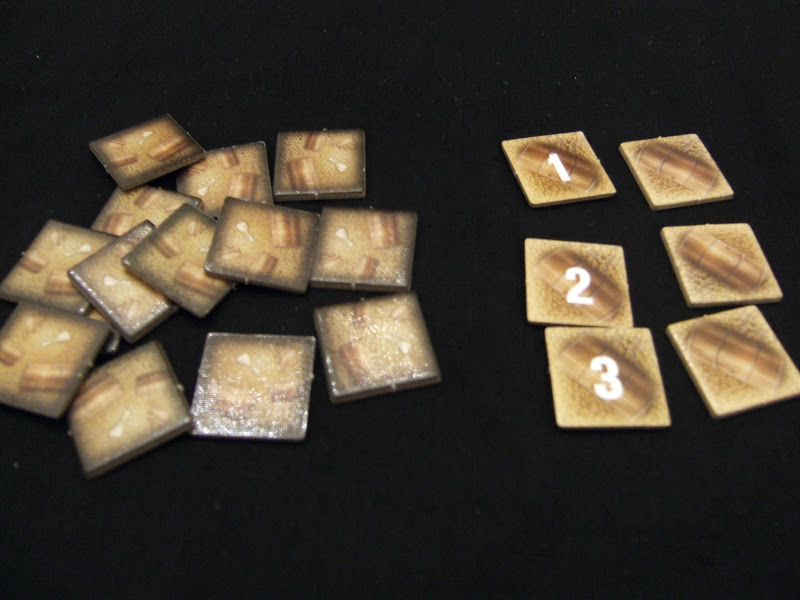
Each set comes with 12 pre-painted D&D minis which are mostly reprints from the old line of the Dungeons and Dragons Miniatures games, 2 big 8x8 jigsaw fit tiles and 2 little 8x4 end tiles, a bunch of little tokens representing Hit Points for the figures, and some tokens to differentiate between duplicate minis.
The tile art is fantastic, some of the best in fact – by the very talented Jason Engle, and the tiles are double sided to allow for indoor dungeon and outdoor grassland arenas.  But you only get four tiles in each set, which means you’ll play through the variability of these setups in short order.
Full colour art on all the cards!  WOTC dropped the ball with this big time on the D&D AS games, and up until those games released it kind of became the standard to get decent looking cards in fantasy adventure board games.  With expectations duly lowered with monochrome decks and single colour hero cards it was nice to see them step it back up for Dungeon Command (and Lords of Waterdeep).  Some of the art is really nice, some not as good, but on the whole pretty impressive stuff, and nicely thematic for the D&D setting.
The minis are pretty good quality with wildly varying quality paint jobs.  From a non-painter’s point of view it has to be said that some paint jobs are pretty shocking in fact.  One wonders how much WOTC would have saved had they simply included unpainted models, without seriously impacting the overall quality of the product.
And there are no dice – but this is D&D heresy!  I actually think this is a really good thing.  Having the characters deal out a set amount of damage with each attack allows the designers room to develop boosts for these attacks through play of order cards and by making attacks Sneaky or Poisonous or whatever.  So yes, a dice-less D&D combat board game – but it works.


Some not so good:

The rulebook is coarse but paper thin and feels like a homemade print out more than an official glossy manual – a big step down from the Adventure System games.  As is the game box itself, which is made from flimsy card which does not feel like it will last the test of time at all.
Hit Points and damage, etc are in tens instead of units.  This adds an extra layer of maths (well, an extra zero anyway) to the proceedings, but is supposedly designed to make you feel like characters have lots of health and are inflicting tons of damage.  It’s unnecessary, but hardly game breaking.
The plastic insert housing the minis takes up most of the box and was the first thing to go.  Whilst it serves a purpose in preserving the minis from damage players should take extra care to prise the minis from their homes as the various bending appendages or pointy swords and weapons can undergo undue stress if one is not careful.
And there are no....  umm....  dice - D&D heresy for sure! 


How does it compare to the Dungeons and Dragons Adventure System games?

The comparison isn’t really fair because the AS games are cooperative dungeon exploration games, but if you imagine them more abstractly as a sort of minis skirmish game where one side is the players’ heroes and the other side is the game’s AI monsters, you’d actually get a fairly close approximation.  Mainly because the order cards in Dungeon Command add so much variance to the proceedings.  Whereas in the AS games you could draw traps and encounters and use hero powers to attack, in Dungeon Command you’ll actively be playing these cards from your hand against your opponent instead.

As it is, the games stand side by side nicely – one for a cooperative dungeon crawl fix and one as a competitive tactical skirmish game.  The cards supplied in Dungeon Command to allow you to use your figures in the AS games are a really nice touch, and it wouldn’t be difficult to convert other D&D minis into the existing Dungeon Command system.  In fact, many fans are already doing this as we speak.


Is it any good?

Yes.

There’s a deceptive amount things happening at once in this game, and it feels like there is always something to be doing, even during your opponent’s turn.  Because of the nature of the card play, you can play some effects during your opponent’s attacks, deflecting blows or escaping from attack, or Cowering.  The upshot of this is that the downtime feels very minimal once you both have a handle on the game, although some decisions can be appropriately agonising.

Considering that this was purchased primarily as in expansion addition to the cooperative D&D board games it has been an absolutely pleasant surprise to find a wholly playable and intensive skirmish battle game in Dungeon Command.


Summary

Whether or not you have a vested interest in the D&D franchise Dungeon Command makes for a great, light skirmish game, with deeper tactics emerging through devious card play and positioning, and which can be played in under an hour with a little experience under your belt.  With a ton of new expansion material in the works too, there should be a wealth of further replayability and variability beyond what is already in the box.

If you can find a decent deal on the first two sets and you’re looking for a lighter fantasy skirmish game, jump on in.

Pros:

•           Fun, tense game!
•           Beautiful tile art with varying terrain effects
•           Interesting order cards with colour art and cool, thematic in-game effects
•           12 cool minis with varying quality paint jobs
•           Lots of replayability in the Order card decks, less so in the creatures available (unless you buy more boxed sets...)
•           Fast paced – actions are resolved quickly and easily with no dice rolls!
•           Simple, easy to learn rules
•           Tons of expansion material in the works (this could be a Con if you’re a completist)
•           No dice!


Cons:

•           Price – make sure you get a deal, as this can be over-priced for what it is (your country’s price may vary)
•           Space-consuming plastic insert – be careful popping out your minis!
•           Crappy paper rulebook
•           Crappy paper box
•           No dice!  (just kidding – this is a big bonus in this game)


Tristan Hall is a board game player and designer, avid video gamer and movie lover who juggles life as a writer, producer and Dad with his insatiable appetite to crowbar playtime into an otherwise prematurely grown up existence.

Forum username: ninjadorg

Monday, September 10, 2012

Monday, November 14, 2011

Legend of Drizzt: Hero Levelling cards for campaign play


Legend of Drizzt: Hero Levelling cards for campaign play

The following are the Levelling Hero cards for the Heroes of Legend of Drizzt.  They are for use with the Dungeons and Dragons Adventures System campaign rules which can be found here:


Thanks to Malone76 and GeckoTH for the templates!

Monday, October 24, 2011

Friday, October 21, 2011

Legend of Drizzt – 2 player session report


Unable to wait for friends to play with I broke open Legend of Drizzt and played about ten solo games after picking it up from my FLGS a couple of days ago.  Winning every game led me to believe that the heroes are a tad stronger in this title than in Castle Ravenloft or Wrath of Ashardalon (and they are).

So when Mmzomba dropped round last night for a gaming session with his brand new copy of Game of Thrones: LCG (boy, are our fingers on the pulse or what?) we contemplated for about 3 seconds which title to play.  Our third player didn’t turn up because he had some kind of ‘date’ with his ‘girlfriend’ - poor lad needs to sort his priorities out.  So we opted for a night of intensive 2-player dungeoneering over political wrangling, intriguing and power token challenging.  Or whatever.  (Still want to try GOT: LCG btw, TV show rocked, made me buy the book, read the prologue, remembered how I never have the time to read books anymore...)

Since Mmzomba plumped for Artemis Entreri we skipped the adventure where Artemis is the baddie and started with the Shimmergloom adventure, i.e.  ‘Find the shadow dragon Shimmergloom, rip his heart out and then show it to him as he dies’ or something along those lines.  If he was going to play the coolest character from the books then I’d obviously have to play the second coolest...

Mmzomba began to grow dubious early on when in my first turn as Drizzt I summoned his pet panther Gwuenwhueevhuarrrarrrer, went into Last Blood Stance drew a monster, jumped forward and chopped said monster into bits and grabbed the treasure spilling from its guts, then had Guen come over and eat the leftovers.

Artemis wandered the caverns, revealing monsters and using his batshit crazy ability to place them on any tile, whilst Drizzt jumped around going “hi-YAH!” and murdering the poor things.  When I finally missed two attack rolls in a row against a measly goblin Mmzomba’s eyes lit up at the prospect of being able to finally attack something.  But Guen jumped over and swallowed the cowering little archer in one gulp.

By the time we reached the Dark Chasm goal tile we’d stocked up on treasures, healed the few injuries we’d taken, Artemis had killed a couple of beasties too (by deliberately placing them away from Drizzt so he could get there first), and we’d both commented on how the new tiles and encounters had great little evocative effects on them.  Volcanic vents igniting lava, narrow tunnels suffocating movement, a hidden tunnel providing short cuts, a secret cave giving reprieve from encounters, a campsite offering temporary safety.  We also learnt to get rid of Lolth’s Curses as soon as possible.  Said Curses only affect you once each time in solo play, but with more than one player they can rapidly start to dish out the damage if you don’t manage them effectively.

Even so, as Drizzt and Mr Entreri sauntered into Shimmergloom’s lair there was only one creature in the Underdark quaking with fear.  The poor dragon put up a meagre defence as we leapt in and tore him a new one.  With two untouched healing surges and maybe 4 HP damage between us it was a relatively unchallenged victory.

After discussing possibly house-ruling Drizzt to one attack per turn we quickly decided to put Mr D’O and Mr E to one side for the time being.  Instead we took Bruenor and Catti-Brie on the quest to save Wulfgar from Errtu the big nasty Balrog who isn’t really a Balrog because his sword is made of lightning not fire, see?

This was a much closer game.  After laughing confidently about our incredible hero powers we ventured forth into the dungeon only to have a Feral Troll appear and start wind-milling its gigantic arms at us.  Catti-Brie ran off and continued exploring whilst Bruenor was beaten to the floor by a rather exciting NINE HP of damage from 3 consecutive Troll attacks.  Spitting a tooth and wiping his mouth, Bruenor got back to his feet and snarled at the troll, “That all you got?”

Then, in a flurry of blows and curses Bruenor brought the troll to its knees before sending its head whirling into the Underdark.  There’s basically no point attacking a troll unless you’re going to take it down fast.  Troll regeneration in LoD is nasty.  And in a two player game they activate every turn, like a villain, so you really have to take it down if one appears.  If two appear together, well, time to go home really.

We ploughed on and when the “Secret Cave: Spa and Hotel Retreat TM” appeared (which stops you from having encounters whilst you’re on it) we made good use of it, Catti-Brie even discovering a Hidden Tunnel that would lead us there and back when we needed it.  As Bruenor finally found the Crystal Shard objective tile Catti was well behind and still discovering tiles but our HP was running low.  Bruenor’s healing Dwarven Ale had long ago been consumed, but a lucky encounter with some moaning spirits had provided him with a Blinding pair of Bracers which allowed him an extra attack each turn.

Errtu the bigass demon appeared, snarled and stalked towards Bruenor swinging its sword and whip.  Catti meanwhile opened up a narrow corridor from which Dinin the Drider emerged.  Quickly realising she was not remotely equipped to tackle the 3HP Drider, Catti ran away and hid in the Secret Cave which meant that the Drider scuttled over at a pace towards the already beleaguered Bruenor.

Realising I was going to be attacked multiple times by two of the toughest enemies I had to decide who to take down first.  Errtu was blocking the path towards Wulfgar, who was trapped in the crystal prison, so I couldn’t free him as an ally and get his help.  But the Drider would keep chipping away at me until I took him and Errtu down.  So I turned my attention to Dinin the Drider.  With a mighty axe swing, a nifty application of one of Bruenor’s Power Strike tokens (+1 damage) and a desperate Headbutt, Dinin the Drider collapsed into a heap of wiggling spider legs.  His treasure was the Girdle/Belt of Storm Giant Strength (+2 damage on adjacent hits).  This is LoD’s ‘Holy Avenger’ or ‘Captain America Shield’.  Awesome.

Sprinting away and strapping on his new belt Bruenor turned to face the demon.  Catti considered exploring because she didn’t want to feel left out, but was also too far away to help battle the demon.  So she revealed a new tile along with a Goblin Archer, took a shot at him with her bow, missed, and got taken down in a hail of goblin arrows.

Errtu stalked after Bruenor and bellowed some curses about Drizzt, who incidentally wasn’t there anyway.  Psyching himself up Bruenor charged the demon and attacked repeatedly.  With a natural 20 level up, using up his remaining power tokens, and by applying the power of the Giant’s Belt and Blinding Bracers, Bruenor started hacking big chunks out of the demon.  The demon struck back repeatedly but Brunoer held.  Catti spent a healing surge to get back up after the goblin’s attacks and shot the little critter through the eyes.

Then Bruenor took his axe in both hands and leapt at Errtu.  With a mighty swing the dwarf’s axe put paid to Errtu’s retirement plans and the demon fell to his knees, looking the dwarf in the eyes.  As a final insult Bruenor stepped forward and head-butted Errtu in the face.  The demon squealed and clutched its broken nose, before falling back over and expiring.

Blowing through all our collected XP to keep encounters at bay we legged it to the crystal shard and smashed it apart setting Wulfgar free and winning the game.

No healing surges left and about 4HP between us this was indeed a much closer session.

And for our final game we played Athrogate and Jarlaxle defending Mithril Hall against the invasion of Matron Baenre and her relentless armies.  This adventure uses the fixed cavern setup and is pretty cool, although you’ll have to fudge some of the encounter events.  For example, I drew a “draw a tile and place it, then put your hero on it” event which would have effectively taken me out of the game straight away.

Basically, running around smashing up fissures to collapse them, and then defending against the monsters coming through the open fissures is the order of the day here.  Whilst I as Jarlaxle was intent that we get the fissures closed as a priority, Athrogate wanted to fight stuff instead.  Which meant monsters kept emerging and keeping us back from our ultimate objective.  And when Lolth’s servant, that nasty Matron Mother arrived we were immediately put under enormous pressure having to deal with her, the encounters she potentially reveals, the monsters pouring through the fissures, and having to destroy the final two open fissures.

Athrogate’s morning star ‘Cracker’ led to an interesting rules situation as it inflicts a -4 AC on baddies.  So can you just keep doing this until you bring a Villain’s AC to zero?  We house-ruled, “no, that would be silly.”  But then I had the Dark Fire ability too, which also brings an enemy’s AC down by 4.  So could I use this in addition to Athrogate’s Cracker and bring the villain’s AC down by 8?  We house-ruled, “no, that would also be silly”.  So I used it on a water elemental instead.  The poor thing died soon after.

After much fighting, running and swearing, eventually Athrogate manged to close the final fissure and Jarlaxle nuked a bunch of underlings with a careful blast of the Lightning Wand.  Then it was just us and the Matron.  She chopped us down a couple of times and poisoned us both, so we spent a healing surge or two before bringing her to her knees and then bashing her skull in.  At that point it was game over, midnight, 3 victories under out belts, and an end to the evening.

Loads of fun and lots to enjoy in this game: cool tile effects, really thematic implementation of hero abilities and monster/villain skills and card and tile effects.  We both felt like there was more to do as the heroes, more options and decisions to make about how to use stances and powers.  Even some strategy about which tiles to move to, and some negating of kiting tactics by monsters who don’t care for kiting heroes (hello teleporting Drow Wizard).  But a huge leap in favour of the heroes in general I feel.  Clearly the designers wanted the Companions of the Hall to be kickarse, and it shows.  I really want to send Drizzt up against Strahd next and see how he fares.  But that adventure belongs to another day...


Wednesday, October 19, 2011

The Legend of Drizzt Design & Development by Peter Lee

Dungeons & Dragons Roleplaying Game Official Home Page - Article (The Legend of Drizzt): "The Legend of Drizzt
Design & Development"


'via Blog this'


he Legend of Drizzt™ Board Game is the newest addition to the Adventure System. In this Design & Development article, you'll see what's new in this follow-up to Castle Ravenloft™ and Wrath of Ashardalon™.


Heroes and Villains

One of the first requirements of an Adventure System game is a cast of characters. I wanted The Legend of Drizzt Board Game to be a celebration of the entire line of novels written by R. A. Salvatore, so the Champions of the Hall were obvious choices for the players' Heroes.
Each Hero must be exciting to play, because players interact with the Heroes more than any other aspect of the game. Having Heroes based off characters from the novels requires that the characters feel right. Drizzt is a whirlwind of flashing blades, while Regis skulks around and explores nooks and crannies.
To illustrate the best fighters, three of the heroes have a new mechanic: stances. A stance is a choice you make that allows your abilities to shift throughout the game. Bruenor can hide behind his shield, or forgo defense to hustle into battle. Cattie-Brie can be extremely accurate or extremely deadly.
The villains of the novels are nearly as important as the heroes, so characters such as Artemis Entreri and Jarlaxle Baenre needed to appear. Choosing the secondary villains was much harder. I first needed to figure out what monsters the heroes would battle in the game.

Multitude of Monsters

Drizzt has fought a ton of monsters, so I had a lot of choice in selecting the creatures to include in the game. Although drow were an easy addition, it was much tougher to figure out the rest of the foes to include. My first instinct was to add King Obould and his horde of orcs, but we just introduced orcs in Ashardalon. Instead, we went with goblins, which provide a nice counterpoint to the drow and serve the entire Adventure Series well.
After selecting the Monsters, I made changes to the Monster deck. One comment about Castle Ravenloft was that the Monster deck is too predictable: explore a tile, place a monster. In The Legend of Drizzt, we included a few Monsters that don't appear exactly three times in the deck. This change allowed me to include a few large miniatures that aren't villains. It felt right for Drizzt to turn the corner to discover a lumbering troll or drider. Also, for the first time, the Monster deck includes events. Instead of always discovering one monster, you can find a hunting party of monsters or no monsters at all.

The Underdark

Many of the iconic locations in R. A. Salvatore's novels are in the Underdark, so I felt the majority of the game's Adventures should be set there. This setting required a new style of art for the tiles.
In Wrath of Ashardalon, we introduced a few tiles that had game mechanics, such as the Long Hallway. Since one of the core elements of this game is exploration, in The Legend of Drizzt, I added even more mechanics to tiles. The simplest tiles, such as the Long Hallway or Secret Cave, introduce small benefits or disadvantages. Other tiles, such as the Volcanic Vent, don't have explicit rules on the tile, but they have links to the Encounter deck that triggers an effect.

First Time Play

It can be daunting to sit down to play an Adventure System game for the first time. One way we helped the first-time player was to divide the card decks into a starting version and an advanced version. Most of the people reading this article can dive straight into the advanced version, but if you're teaching new players, the starting deck helps.
Alternate Ways to Play
For this third release of the Adventure System, I wanted to provide alternate ways to play the game. The villains in R.A. Salvatore's novels are compelling characters, so I introduced competitive play through Artemis, Jarlaxle, and Athrogate to support the stories and offer new mechanics.
The competitive Adventures feature some exciting events that occur in the novel line. One such adventure features Artemis, Drizzt, and Cattie-brie escaping from the Underdark. Artemis has no obligation to keep the renegade drow alive, but Drizzt offers some protection. In other words, Artemis doesn't have to outrun the Monsters, just Drizzt and Cattie-brie.
In addition, a few adventures don't include an exploration mechanic. Instead, you build a set of caves and try to stop waves of Monsters. In the Adventure featuring the drow's attack on Mithral Hall, the heroes must close off the tunnels that the Monsters are using. In another adventure, the Heroes are simply trying to defeat the most Monsters in a competitive way.

A Final Anecdote

At GenCon this year, I was lucky enough to show this game to R. A. Salvatore. We didn't have a lot of time, so I chose the Heros' powers so we could start playing immediately. Bob played Regis, and he spent much of the second half of the game darting in and out of the Secret Cave, a tile where you draw no Encounter cards. At one point, another Hero was hit with the Fall through the Cracks event, a card that removes your Hero from play until the start of your next turn, at which point you emerge on the start tile. Bob remarked that it was the perfect card for Regis! I then happily pointed out Regis's Hide utility power card, which does something very similar. It was a long road to get the Heroes to feel like the characters from the novels, but I think the effort was well spent.

Thursday, September 08, 2011

Dungeons & Dragons Roleplaying Game - D&D Skirmish Board Game Playtest

D&D Skirmish Board Game Playtest


Dungeons & Dragons Roleplaying Game Official Home Page - Article (D&D Skirmish Board Game Playtest): "D&D Skirmish Board Game Playtest"

Worth a look now that we all have tons of minis from Castle Ravenloft and Wrath of Ashardalon...