Hall or Nothing Productions Ltd

Wednesday, April 13, 2011

The Complete Castle Ravenloft Campaign Experience!


HERO LEVELLING CARDS for D&D Adventure System campaigns by Malone76:


And now the decks are up on Artscow!
Named Tiles 1
http://www.artscow.com/gallery/card/named-tiles-6b9rn92ixm8j
Named Tiles 2
http://www.artscow.com/gallery/card/named-tiles-scsspou44lsf
Named Tiles 3
http://www.artscow.com/gallery/card/named-tiles-3lep5i3jaouo


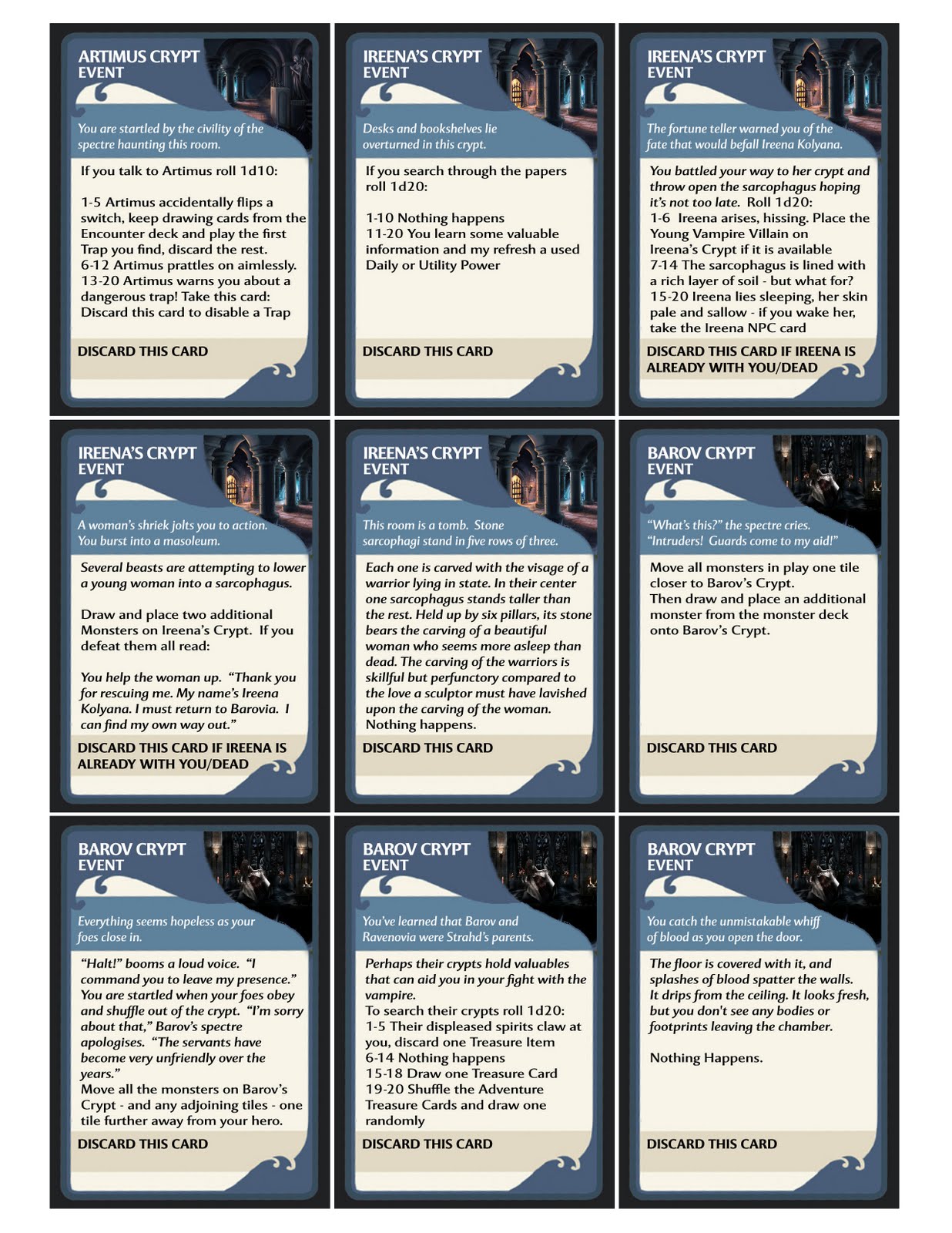
People want the Named tiles to really mean something and affect gameplay.  So with the help of Crimso and Autoduellist from BGG we’ve developed this deck of cards to add more random variety and theme to the Named Tiles.

You can use them along with the Chamber Decks to create random adventures for campaign play, much like Warhammer Quest.

1  All the Named tiles for WOA & CR are removed before the adventure begins and shuffled into a separate Named tile stack.
2   Named Tiles are randomly selected before the adventure, and seeded into the 'regular' tile stack based on Pary Level.  Party Level is determined by the LOWEST level hero in the party:
For Party Level 1 shuffle one Named Tile into position 1-6 in the regular tile stack
For Party Levels 2-3 shuffle one Named Tile into position 1-6 in the regular tile stack AND shuffle one Named Tile into position 7-12 in the regular tile stack
For Party Levels 4-5 shuffle one Named Tile into position 1-6 in the regular tile stack AND shuffle one Named Tile into position 7-12 in the regular tile stack AND shuffle one Named Tile into position 13-18 in the regular tile stack
3  Then add a Chamber tile at position 9-13.  For Party Levels 4-5 shuffle ONE EXTRA Chamber Tile into position 15-18
4  Each time a Named Tile is drawn, draw a card from the appropriate Named Tile deck instead of a regular encounter (even if the Named Tile has a white arrow).
5  When a Chamber is drawn, randomly draw a Chamber card as usual.

Generally this will mean the hero experiences the Named Tile Event before he actually lands on that tile, but I don't have a problem with that - I think it'll just be easier to deal with as soon as the tile is drawn than try to remember that tile for the rest of the game.

This way you'll get even more variety than the Assault on Firestorm Peak campaign adventure, plus I can really road-test our new campaign rules. And, of course, even more variety will come as more and more Chamber and Named Tile cards are added to the decks too!


Here are my current rules for campaign play:


For each level you gain +2HP, +1 AC, +1 Surge Value plus:

Level 2 = 1 new Daily
Level 3 = 1 new Utility
Level 4 = 1 new At Will
Level 5 = 1 new Daily

And the cost for levelling is:

Level 2 = 10XP (you can still level up to Level 2 using 5XP and a natural 20, but not to Level 3+)
Level 3 = 20XP
Level 4 = 30XP
Level 5 = 40XP

You have to make a note of XP between adventures though because the monster cards need shuffling back into the deck to restock the dungeon each time.

Also, no hero can reach a new Level until all Heroes have caught up to his current level, so you couldn't have a Level 5 hero in the same party as a Level 1 hero for example.

To scale the game to fit tougher heroes, you start drawing Monster Tokens (from Castle Ravenloft) instead of just placing one Monster when you draw a new tile.  Party Level is determined by the LOWEST level hero in the party:

0-3 creatures for Party Levels 1-2
1-3 creatures for Party Level 3
1-3 creatures for Party Level 4 (with minor villains mixed in)
2-3 creatures for Party Level 5 (with all villains mixed in)

Optional Encumbrance Limits

1 hero may carry 20 treasure items
2 heroes may carry 10 treasure items each
3 heroes may carry 7 treasure items each
4 heroes may carry 5 treasure items each
5 heroes may carry 4 treasure items each


You'll need to use the Treasure Tokens from Wrath of Ashardalon for best effect, buying up to three new treasures between adventures.  Shuffle the treasure decks from both games together, but when you're buying, re-draw any non-item cards.


And here are the event cards:


And here are the Chamber cards for use with Castle Ravenloft:


And if you want all the cards to have the same backs to randomise the deck completely you can use these backs instead:


And for between adventure encounters to string the campaign along you'll want the Events deck:


This is a Suggested Treasure Item price list for Castle Ravenloft fitting into the WoA Campaign Rules along with these campaign rules in a pretty format:


Here's a levelling chart for use with Castle Ravenloft, Wrath of Ashardalaon or Legend of Drizzt:


Friday, April 01, 2011

D&D Adventure System BASIC CAMPAIGN RULES


BASIC CAMPAIGN RULES


They need more road testing and currently only go up to Level 5, but since you asked here are my current rules for campaign play:


For each level you gain +2HP, +1 AC, +1 Surge Value plus:


Level 2 = 1 new Daily
Level 3 = 1 new Utility
Level 4 = 1 new At Will
Level 5 = 1 new Daily


And the cost for levelling is:


Level 2 = 10XP (you can still level up to Level 2 using 5XP and a natural 20, but not to Level 3+)
Level 3 = 20XP
Level 4 = 30XP
Level 5 = 40XP


You'd have to make a note of XP between adventures though because the monster cards need shuffling back into the deck to restock the dungeon each time.


Also, no hero can reach a new Level until all Heroes have caught up to his current level, so you couldn't have a Level 5 hero in the same party as a Level 1 hero for example.


To scale the game to fit tougher heroes, you start drawing Monster Tokens (from Castle Ravenloft) instead of just placing one Monster when you draw a new tile:


1 creature for Hero Levels 1-2
1-2 creatures for Hero Levels 2-3
1-3 creatures for Hero Levels 3-4 (with minor villains mixed in)
2-3 creatures for Hero Levels 4-5 (with all villains mixed in)


Optional Encumberance Limits

1 hero may carry 20 treasure items
2 heroes may carry 10 treasure items each
3 heroes may carry 7 treasure items each
4 heroes may carry 5 treasure items each
5 heroes may carry 4 treasure items each


I'll post more details once I have the campaign rules down, but further scaling - using randomised Objective tiles - will also mean that the higher level heroes will have to go further into the dungeon to win, i.e. objective tiles start getting placed further down the tile stack (12th-15th instead of 9th-12th, for example).

Friday, March 18, 2011

D&D Adventure System Index - NinjaDorg's Stuff So Far..


I'm posting this in response to a few requests in case anyone else was wondering too - it might not all be of interest to you but I've posted it here anyway for the sake of unity so you can pick and choose what you want (or ignore it all completely):


NEW HEROES

NinjaDorg's Heroes 1st Batch


GEEKLISTS

Geeklist of unofficial user-created Adventures
http://boardgamegeek.com/geeklist/59113

Geeklist of unofficial user-created Heroes
http://www.boardgamegeek.com/geeklist/59567


D& D ADVENTURE SYSTEM CAMPAIGNS

Event Deck for Castle Ravenloft

Event Deck for Wrath of Ashardalon

Castle Ravenloft Chamber Cards

Castle Ravenloft Treasure Items price list

Kobold Wars Adventure for Castle Ravenloft+Wrath of Ashardalon


OPTIONAL RULES

Castle Ravenloft Scoring Rules - by Peter Lee

The Calling of the Grey Hag


TEMPLATES

Levelling chart for campaign rules in D&D Adventure System

Castle Ravenloft Villain and Power card-back templates

Castle Ravenloft Hero Power card templates

Blank Hero Card for Castle Ravenloft

Scenario Template

Editable PSD for Adventures "Kobold Wars" Template
http://www.4shared.com/photo/S8IQLAFH/Kobold_Wars.html


ARTICLES

Wrath of Ashardalon arrived – solo questing underway

NinjaDorg’s ramblings on the solo aspects of Dungeons & Dragons: Wrath of Ashardalon

Wrath of Ash campaign play – our first run of Against the Clans!

Thursday, March 17, 2011

Defenders of the Realm - Royal Blessings Official Variant by Richard Launius


NinjaDorg’s ramblings on the solo aspects of Dungeons & Dragons: Wrath of Ashardalon

Here's the original article first published on the awesome solo nexus which you can visit here....

http://solonexus.blogspot.com/


Quick overview of the system

The Dungeons & Dragons Adventure System consists of the board games Wrath of Ashardalon and Castle Ravenloft (and also Legend of Drizzt, which is coming in October), which are basically the same game but with different themes: Dragons and Orcs for Wrath, Vampires and Undead for Ravenloft.  Both games are hack and slash dungeon crawlers based loosely on their original D&D modules that build a random dungeon for you to explore by drawing room tiles, random monsters - and random treasures when you defeat them - and dangerous encounters.  Today I’ll be focusing on Wrath of Ashardalon.

It’s Dungeons & Dragons stripped down to a very light version with no Dungeon Master and it clocks in at about an hour per Adventure, unlike some other Dungeon Crawlers around today (ahem, Descent, ahem).  You can also string adventures together to create ongoing campaigns keeping the same hero/es as you go.  It’s entirely cooperative, although you could choose to compete for most kills/treasures/experience/whatever, so you’ll either be adventuring with your hero mates or going it alone.

You choose a party of archetypal heroes (wizard, fighter, cleric, rogue or paladin) or a single hero, select their powers and set out to achieve an objective defined by the particular scenario you choose.  There are about 12 adventures in each game, but with tons of support from both Wizards of the Coast (who have already released 6 bonus quests just for Castle Ravenloft) and the online community.  I developed an ongoing geeklist of adventures created by BoardGameGeek users and there are already 29 new user-created quests in the database, which can be found here:


What are the design qualities/mechanics/components of WoA that make it worth the purchase for a SOLO player?

Solo play is clearly a major design consideration for WoA.  Although there is only one Adventure listed as for ‘One Hero (A Solo Experience)’ and the others are listed as ‘2-5 heroes’ there is nothing stopping you from running 2-5 heroes yourself.  Personally, when playing solo I prefer to use just one hero as it’s easier to immerse yourself in the game and you don’t have to keep track of too many working parts.  Luckily all the adventures scale well to the number of heroes because you basically draw one monster and/or encounter per hero each turn.  So it’s straightforward enough to just take one solo hero through all the adventures.  It can be quite tricky too – the adventure book even recommends trying a solo hero “for the ultimate challenge”!

The game has a nifty mechanic called Healing Surges.  Basically, if your hero is knocked down to 0HP by monsters or traps you can spend a Healing Surge to get back on your feet and carry on again.  In the standard game you get 2 Healing Surges, 1 if you want a difficult challenge, or 3 if you want to take it easy.  There are in fact 5 Surge tokens included with the game, so if you’re playing solo it’s nice to be able to use them like inserting coins into an arcade machine and then record your results after each adventure to see if you can use less Healing Surges next time.

The monsters and villains are controlled by a clever AI system that negates the need for an evil player and suits solo play perfectly.  On each monster card there are a list of tactics – you simply read down the list until a tactic applies, usually they’ll move towards you or try and hit you with a ranged or melee attack.  But some of them are a little more cunning and might run off and try and get reinforcements, for example.  There are also NPCs in the game who operate the same way – you read down their tactics to see what they get up to, some might fight the nearest monster, or run for the nearest exit, or hide behind your heroes, one particularly troublesome young lad actually runs off exploring the dungeon and discovering more monsters if you don’t keep him in check!  It’s cool how these little personalities emerge from a couple of sentences of tactics on each card, and it helps you to believe that these creatures have a mind of their own, even if no one is actually there physically controlling them for you.

With 40+minis (and a couple of biggies – the red dragon is mahoosive!) in the box and 40+ dungeon tiles the price tag would be worth these pretty bits alone.  The fact that it also contains an infinitely re-playable, simplistic and fast-moving dungeon crawling system is a gigantic strawberry on top of the icing on the cake.  And for those D&D 4E role-players out there this much stuff in one box must be a godsend: orcs, kobolds, bears, snakes, cultists and more.  My gang used to role-play tons when we were kids but we never have the time anymore as adults with families and jobs and stuff.  So this game makes a great quick fix to fill that void, and hits all the major points without getting bogged down in too much story-telling (although it is capable of building interesting narratives) or heavy mechanics.  I always resented rolling tons of dice in Descent: Journeys In The Dark and having to count endless pips and check powers and skills and weapons and everything else, in WOA you simply roll 1d20 and apply the results.  Simples.

You can play each of the adventures as a stand-alone quest each time and try different combinations of heroes and powers, and you’ll get a different experience every time because of the random tile/monster/treasure/encounter draws.  But for me the campaign rules edge Wrath of Ashardalon just above its predecessor Castle Ravenloft, because there’s nothing cooler than taking your hero from strength to strength between adventures, gathering gold and treasure, and watching them grow tough enough to try and take on the big red dragon himself....


How open is the game to personal customization?

This game is all about customisation, in fact it begs for it.  The actual Adventures included each have individual scenario-specific rules that are all jigsaw pieces of a bigger picture, of what you can achieve if you combine them all together.  You won’t want to mix them all up at first because the game gradually introduces you to each concept one at a time, but eventually you’ll be building your own scenarios and looking at ways to utilise everything at once and add in your own stuff too.

For example, one quest has you navigate a path through a series of Doors that can be Trapped (causing damage), Locked (causing you to look for another route or waste time trying to open them) or Unlocked.  After you’ve played this through a couple of times, there’s no reason you can’t include Doors in every Adventure you play from now on.

There are also Chambers, which are much bigger rooms that you encounter at the end of certain dungeons which house the final boss or goal of that dungeon.  You can draw the Chamber randomly from the 14 Chamber cards included, or you can easily design your own for an endless variety of quest objectives.

The monster/NPC tactics mentioned above also make it incredibly easy to design and include your own mods suitable to whatever minis you already own.  If you sleeve your cards you can just slip a bit of paper in front of the existing monsters with your own scribbled concoctions and bring into play all sorts of combinations of bad guys or villagers or whoever you feel like meeting and/or beating the crap out of.  There are tons of fanmade monsters on the ‘Geek and some people have even developed entire Artscow monster decks to replace the existing official versions.  You can check out Ignazio Corrao’s custom Monster deck here:


The heroes themselves are also easy to create and play-test, and I’ve put together a geeklist of the existing fanmade heroes built by the community which can be found here:


As you can see, pretty much every aspect of this game is easily customisable.  It’s a very elegant and effortless system that can be built upon or added to very easily.  For example, I prefer the campaign style of play, so along with some other BGGers we came up with story events that affect your hero/es between adventures, similar to those from Warhammer Quest.  These help string multiple adventures together and provide a bit more depth to the whole experience.  You can see the results of our efforts here:


Finally, for a fairly broad session report on how the game actually plays out as a solo experience you can check out my blog entry on the experience here:


I hope this clears up some questions you might have about the game, I tried to avoid a classic review style and just stick to the topics outlined, but if you have any other queries just comment below or hit me up at the blog.

Cheers for your time!


ND


Monday, March 14, 2011

Defenders of the Realm - first play session report


Okay, so I’m pretty late to the bandwagon with this one.  But we've had trouble getting Defenders of the Realm in the UK: first it took ages to land on our shores, then it apparently sold out on pre-orders, and shipping from abroad was horrendous.  Then when it did arrive the cost was much higher than we'd anticipated. But we've finally managed to bag a brand new copy and might I just say: thank heavens for that!


We played through our first two games at the weekend - 2 two-player games. First game I was the Ranger and Mmzomba was the much more mobile Paladin.  I picked the Ranger because it’s always been my favourite class (Fellowship of the Ring, aged 12, Strider, nuff said) and the green forestry abilities looked cool.  I also really liked the idea of shooting at adjacent enemies without any comeuppance.  I don’t really blame the Ranger for this but boy, oh boy, did my uppance come.

The Paladin has some fancified skills too, particularly his ability to sit contemplatively on his horse, leaning on an enemy minion’s head with one hand and pontificating about righteous smiting whilst they flail at him uselessly with their short arms; i.e. he takes no damage from remaining in a space with one minion.

The rules were easy to pick up, although we mucked up the taints a little bit in the first game and had to do a bit of real life 'Ctrl+Z'ing after starting an unstoppable taint/overrun chain which clearly shouldn't have happened in the first place...   But, you know, no harm done.

So we gingerly set off, worrying about how many cards we’d need to take a general out, and how quickly the bad guys were spawning as we burned a couple of our cards in moving around a bit further, and hammering on the minions where we could.  Where possible I tried to leap from green space to green space, netting me an extra action and a bonus to attacks, but even against weak-ass orcs I still rolled a shocking number of snake eyes, even for me, and I’m generally a terrible roller.

Nevertheless we got our game on and we managed to beat up on two generals, making exactly the right number of rolls to kill them one after the other.  We rejoiced and took our respective Slayer cards with every intention of showing off our newfound might on the petty minions sprawling across the world.  And then we got absolutely hammered.  Out of seemingly nowhere, the Orcs spawned through their last few minions leaving none left to draw from when another Orc was to be placed.  Eek!  Gorgutt took Monarch City and stuck our heads on spikes.

Second game, Mmzomba was the Sorceress and I took the Wizard and we relished our new skillsets.  The Wizard’s once per turn teleport is amazing, and the choice of burning a card to fireball enemies added a really nice touch.  I almost forgot to use his Wisdom ability to discard Darkness Spreads cards, but we fared much better this time.  The Sorceress is super-hard too, taking on the forms of her enemies; she was jumping into their midst and then slaying the hapless Minions left, right and centre.  At one point the Sorceress had cleared the entire right side of the board, whilst a Dragonkin minion sat at Monarch City quaking in his boots at her approach.  Side-note: After years of balking at the ugly Sorceress from Talisman 2nd edition this particular sorceress is a breath of fresh air!

My Wizard’s teleporting ability allowed me to actually start finishing off quests, which is something we neglected to do entirely in game 1, due to the constant fire-fighting of trying to clear down cursed evil minions.  Before long I had reaped 5 Rewards and towards the end of the game I even bagged myself some nifty Boots of Speed; two extra actions per turn = mega awesome.

Despite some close calls we cleaned up, took down all 4 generals and annihilated their armies en route. Very different feel to both games but really enjoyed it and can't wait to get another session in.

I loved Arkham Horror (epic coop play by the same designer), but I think Defenders really has the edge over it, much cleaner play and a real epic feel to battling the four very different generals. The Darkness Spreads cards deliver the same sort of relentless tension as the Waters Rise cards from Forbidden Island, and presumably the Pandemic equivalent too - only instead of collecting the Treasures (Generals) this time they’re trying to eat you!

The game plays quickly - I’d say one and a half to two hours max for two players but it flies by, turns go at a pace, and you’re also very invested in other players’ turns, which is nice.  Coming from a 2nd edition AD&D background I’m loving the Elmore artwork and the board looks fantastic too, ignore the naysayers, people.

Following the DotR forums was like being teased whilst not having the game.  But watching the game designer, Richard Launius, breathing more life into the game with PnP expansions, answering everyone's questions, building a comprehensive FAQ and describing the thematic reasons behind all his design decisions is just fantastic.  There are a few designers out there who could really do with taking a page out of his book and keeping up with (and repeatedly exceeding the expectations of) their fans.

All in all, this is a really excellent game.  I’m only sorry it took us so long to get hold of a copy.  Right, I'm off to go hunt some orc/defend some realm/get my arse handed to me by Sapphire again...


Castle Ravenloft Chamber Cards first 11


Castle Ravenloft Chamber Cards